
INSIGHTS (on leadership/self-leadership)
Achieving success is hard enough, why would you want to make unhelpful assumptions that actually block your path to success?
It happens. Way more than you think. Here are six common assumptions we make that hold us back from succeeding (and what science tells us about them).
1. “Success doesn’t happen for people like me.” Success is for other people. The people who seem to attract it, were born for it, have all the right conditions working for them, right? Wrong.
Success is as much a self-manifestation as failure is. If you think you aren’t worthy to succeed, you won’t. In fact, Stanford University’s Alfred Bandura has established an entire field of study known as self-efficacy theory that says the link between having strong self-belief and achieving actual success is irrefutable.
2. “Others define success the same way I do.” This is one of the most common issues underlying dysfunctional teams that I’ve experienced. Everyone has a different definition of success which keeps the team from achieving it as a whole, and thus as individuals. Research from Leiden University shows that clear, common goals are linked to enhanced team performance. Furthermore, a classic study from the University of Michigan shows that achieving common goals and a greater sense of interdependence is more meaningful for people than the pursuit of individual goals. Net, take time to understand how all stakeholders see success and work towards a common definition.
3. “What made me successful in the past will work for me in the future.” SEC Rule 156 requires mutual fund companies to inform their investors not to base their expectations of results in the future on past performance. You shouldn’t either, when it comes to any experience you’ve had with success. Sure, there are certain core behaviors like focus and hard work that serve as a foundation, but to treat your entire previous approach as an exact blueprint is a mistake. In fact, an entire science-backed book called What Got You Here Won’t Get You There was written on this. Take the best from what you did before (that’s still applicable) and pinpoint what it will take in a new setting.
4. “It’s all about who you know.” Yes, it helps to be connected. The word I’m refuting is “all.” 60 percent of employees can name at least one time they counted too much on an influential contact to make an opportunity materialize for them. The vast majority of them regret it, wishing they’d instead focused on making career progress happen by focusing more on things within their control (like effort, continual learning, etc.). On the other hand, it’s not just “If it’s to be, it’s up to me.” It’s up to we; the combination of your connections and mentors as well as your laser-focus on your personal contributions towards success. No one succeeds alone.
5. “Real success requires a big, lucky break.” I conducted a thorough review of scientific studies on top factors for success in business and found not a mention of “a big, lucky break” as a driver. Now, it can certainly help, but that assistance is more of an exception than what should be an expectation. The truth is, luck is the intersection of preparation and opportunity. In other words, you make your own luck by being ready to strike the moment success presents an open door.
6. “If I fail en route, I won’t recover.” University of Pennsylvania research showed that grit, the ability to persevere through failures and setbacks, is as important as one’s talent level for success. Suffice it to say, if you fail along the path, you will indeed recover–if you have a recovery mindset and if you remember that every step you take backward pales in comparison to the sum total of progress you’ll have made to date.
IMPERFECTIONS (a mistake I’ve made)
I have an affliction called Charcot-Marie-Tooth disease, it’s a neurological disorder that came along with scoliosis and foot structure issues, as well as some other fun stuff, all in a tidy package. The afflictions create a bow-legged gait, a lot of pain and discomfort, and led to my having both hips replaced at a relatively young age. I use walking sticks when I have to walk longer distances.
But you know what? Boo-hoo. So… what.
Because a long time ago I began ingraining four words in my psyche that helps keep everything in perspective and keeps me on track with my preferred positive attitude and others-oriented outlook.
Everyone has their thing.
No exceptions. And still, sometimes I make the mistake of forgetting that my discomforts pale in comparison to what others might be going through. Over the years, I’ve been astonished at what I’ve uncovered behind the scenes, just at work; what others were going through while trying to keep it together. An employee caring for an utterly incapacitated partner; a victim of excruciating back problems. Another with a life-threatening illness. A co-worker trying to come to grips with the heartbreaking effects of a parent stricken with Alzheimer’s. A boss dealing with a shocking suicide. I’m sure you could create a similar list from people that you know.
By the way, while the luggage everyone is carrying in their life isn’t all as devastating to the naked eye as these things, everyone has their thing, and it’s devastating to them. Maybe it’s someone quietly dealing with a total loss in self-confidence, exacerbated by an unforgiving boss. Or maybe it’s a co-worker who has just found out that the promotion they’ve been working towards for years, the one that’s a big part of their self-identity, is never going to come.
Everyone has their thing.
Doesn’t this human truth warrant a default to compassion in the workplace? Doesn’t it merit a careful consideration of your words and actions before you judge, or worse yet, lash out, at a frustrating co-worker?
So, keep their thing in mind before you do your thing–even if you have no idea what their thing is. Assume it’s there and let it remold and reshape your interactions at work.
We need these four words top of mind. Right now. More than ever.

IMPLEMENTATION (one research-backed strategy, tip, or tool)
Guess what aspect of decision-making is most often overlooked?
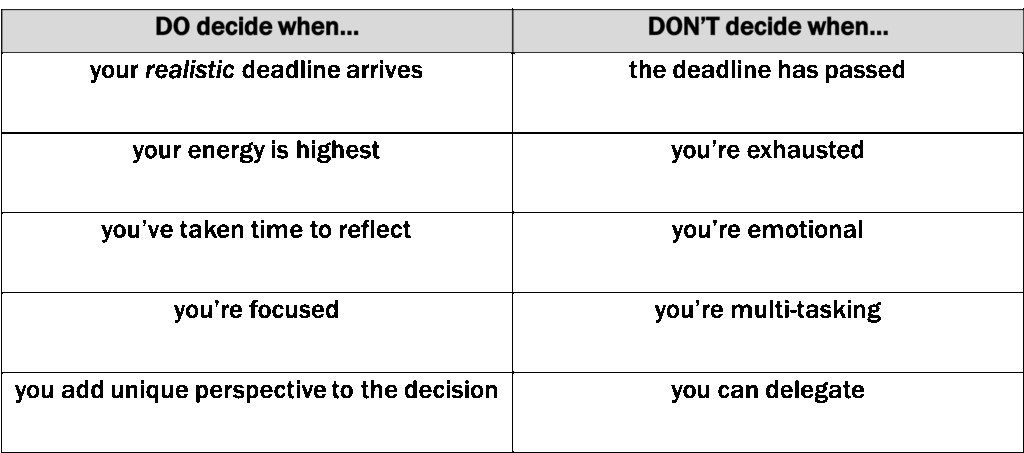
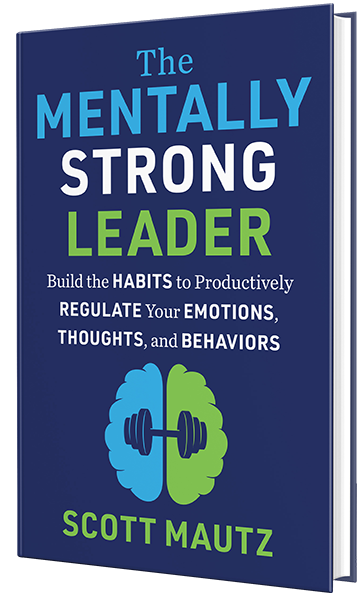
Knowing when to decide, and when not to. To help, consider the Decision-Timing Table (as seen in my book, The Mentally Strong Leader).


Leave a Reply