
INSIGHTS (on leadership/self-leadership)
As a professional speaker who has spent time with many companies, I get asked this question a lot:
“What’s the most overlooked key ingredient in the most successful companies you’ve seen?”
My answer might surprise you.
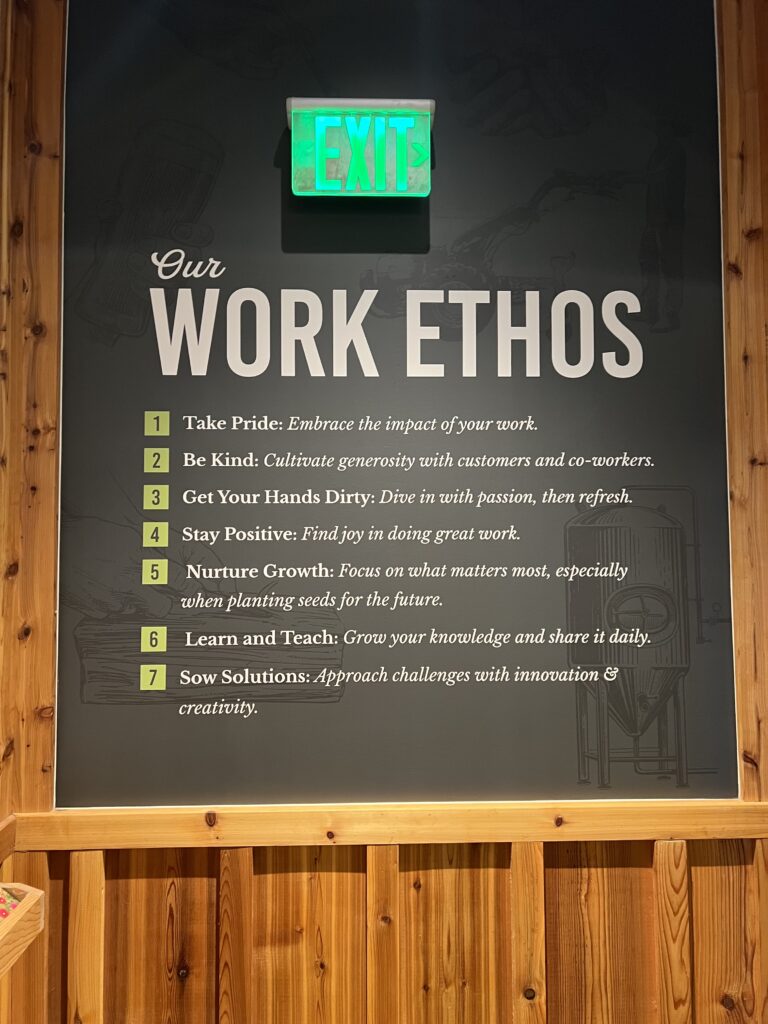
It’s the organization’s work ethos. That is, what does the character of its employees embody? What are the standards for how to be, the principles that guide how to show up, and what’s most important? Within that, I’ve seen a specific work ethos in the most successful companies. And wow, was I ever astonished to find the description of that most effective work ethos, pretty much point by point, written on a plaque on the wall in, of all places, a farm-to-table restaurant compound near where I live in San Diego. Follow this ethos in your organization, and you’ll be far more likely to see success:
1. Take Pride: embrace the impact of your work
2. Be Kind: cultivate generosity
3. Get Your Hands Dirty: dive in with passion, refresh
4. Stay Positive: find joy in doing great work
5. Nurture Growth: focus on what matters most, especially when planting seeds for the future
6. Learn and Teach: grow your knowledge, share it
7. Sow Solutions: approach challenges with innovation and creativity
IMPERFECTIONS (a mistake many make)
It’s an easy trap to fall into. “Must…keep…climbing… the…org…ladder.” Been there. No judgment whatsoever for anyone who’s all about that. But may I share my biggest career lesson?
A career is not always a ladder to climb. It’s not always a series of promotions that feed the dream (someone else’s dream?) of upward mobility. A career can also be a river to ride, taking twists and turns, flowing over and around obstacles in its path, winding until it reaches its pre-ocean pit stop, the delta, a basin of land that’s also the Greek word (and symbol) for change. Then, the river flows onward to its final destination: an ocean of possibilities lived.
See YOUR career journey as unique, not having to follow some typical path, always subject to change, always leading to possibilities. Career happiness and success are what you say they are.

IMPLEMENTATION (one research-backed strategy, tip, or tool)
Here’s a research-backed strategy for being happier.
Do less.
When you create LESS choices for yourself, it helps you avoid what psychologists call the paradox of choice. This says that while you think having many options makes it easier to choose one you’ll be happy with, it actually makes it harder to choose and more likely that you’ll be unhappy with your choice.
For help in prioritizing, simplifying, and saying “no” to more things, all to free up more joy, follow four strategies.
1. Make a pact for impact. Prioritize making the biggest impact on things that matter most, while doing less of the unimportant. To help, keep your “or not’s” in mind. Meaning, before you take on new tasks, ask yourself, “Will this new work contribute to my priorities, or not?” If not, don’t take that new work on.
It also helps to use 20/20 vision. Meaning, work on that 20 percent, most important and urgent of your tasks, while keeping sight of the next 20 percent to work on when you can get to it. The rest, the other 60 percent, can wait, or possibly, be eliminated. Thinking about your work in numerical groupings like this prevents you from drifting down into working on things that just aren’t as important.
For example, maybe you identify the top twenty percent of your work to be time-sensitive things, like getting that report in on time, and items that are critical to your job, like preparing for that big sales call. Then, you identify the next 20 percent as things that are important, that you need to get to as soon as is feasible, but that aren’t urgent, like conducting that competitive analysis. The rest you schedule to work on later, or delegate, or eliminate.
By the way, I’m not saying don’t do maintenance work – things that aren’t as critical but still have to be done. It’s about keeping your portfolio of work dominated by high impact, important tasks or projects, which will lead to a greater sense of satisfaction.
2. Think weights and measures. Meaning, be honest about the weight of any work before you take it on. Stop and ask yourself, “How much work will this really take?” And thoughtfully measure the amount of time you think it’ll take too, remembering that things always take longer than expected – a rule known as Hofstadter’s Law. If the new work still makes the cut, so be it. It’s about careful consideration versus careless over-commitment.
3. Have a “To Don’t” list. This is a twist on the classic “To Do” list. Write down things you want to avoid getting pulled into, like saying “yes” to that co-worker who always asks for favors. The list then serves as a reminder to, well, don’t. Research is clear on the power of writing down your goals (versus just keeping them in your head). This power also applies to writing down goals of what not to do.
4. Addition by subtraction. When you choose to do less, you accomplish more, which adds more joy. Wishful thinking tricks you into believing that if you’re always taking on more and doing more, more will get done, and you’ll be happier. But more often, it just leads to exhaustion and burnout.



Leave a Reply