
INSIGHTS (on leadership/self-leadership)
I received this note from a reader: “Scott, I have a team with all the right people and skills, but they lack one key ingredient – a sense of accountability. What do I do?”
In fact, I’ve received several requests recently on this topic, so I’m bringing it to the top of the list and sharing what follows. If you want your team to act with greater accountability, apply the 25/65/95 Rule (identified in a study by the Association for Talent Development).
Say you’re working towards a goal and you consciously decide you’re going to achieve that goal. The study showed you’re 25 percent likely to be successful.
Now say that you commit to someone that matters to you that you’ll achieve that goal. Your probability of success increases to 65 percent.
But here’s the kicker.
If you hold an “accountability appointment” with the person you committed to (a meeting where you discuss progress on that goal), your likelihood of success jumps to a whopping 95 percent. That’s right. The likelihood of achieving your goal NEARLY QUADRUPLES when you enroll an accountability partner, and hold sessions to discuss progress on that goal with that partner (i.e. “Accountability Appointments”).
I’ve developed a simple agenda for these appointments, whether you’re being held accountable or you’re holding someone else accountable for something. Focus on honestly discussing three questions:
1. Where are we making progress or excuses? The first part of this question is about assessing progress to date, based on measurements you have in place. The second part is meant to encourage honest, vulnerable discussion about where excuses might be predominating.
2. Where are we owning the issue or avoiding the issue? This is about discussing problems that arise along the way in pursuit of the goal. If you’re owning the problem, you’re taking responsibility to address the issue. If you’re avoiding an issue, you’re dodging responsibility, looking the other way, not stepping up.
3. Where are we being brave or blaming? Being brave means openly acknowledging mistakes and discussing what’s being done to fix those mistakes. You also discuss blaming behavior here, where you’ve not admitted mistakes and instead pointed fingers, or even lashed out. Again, not easy discussions to have. But they’re like self-awareness and accountability superglue.
IMPERFECTIONS (a mistake many make)
In the provocative book Paradox of Choice, author Barry Schwartz explains that giving consumers more choice lowers their purchase satisfaction. It creates analysis paralysis, anxiety that the wrong choice will be made, and regret. Often, the best strategy for a marketer is to remove choices to make the set of offerings clearer and the purchase decision more satisfying.
Same thing in life. We have many choices for how we spend our time.
However, research shows that we’re largely unaware of how we spend our time, and even when we are aware, we don’t make enough conscious choices to optimize how we use our time.
So, I ask you this:
What’s one thing you can remove in your life that will make space for what matters?
It could be a relationship, a behavior, a habit, a belief, or a burden. Whatever it is, commit. You won’t increase purchase satisfaction per se, but life satisfaction.

IMPLEMENTATION (one research-backed strategy, tip, or tool)
I’ve studied (and used) plenty of prioritization tools, but few have the simplicity and effectiveness of The Eisenhower Matrix, conceived by and named after former US president and five-star general, Dwight D. Eisenhower. Here’s the Matrix:
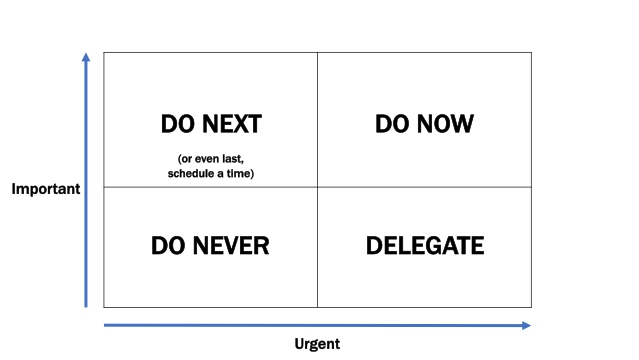
Here’s how it works. Plot your list of tasks on the matrix, considering two fronts – how important that task is, and how urgent it is.
· Tasks that are important and urgent, fall into the “DO NOW” quadrant.
· Tasks that aren’t important, but are urgent, fall into the “DELEGATE” quadrant.
· Tasks that aren’t important or urgent, fall into the “DO NEVER” quadrant.
· Tasks that are important but not urgent, fall into the “DO NEXT” quadrant.
Note that “do next” can mean literally, the next thing you do, or it can mean it’s a task you
need to schedule later, even if it falls to the last task you do on your list.
The real power of the matrix comes when you’re disciplined about:
– doing stuff now that needs to be done now
– letting go and doing the work it takes to delegate effectively
– refusing to do things that don’t matter/add value
– following through on what’s next on your “to do” list


Leave a Reply