INSIGHTS (on leadership/self-leadership)
I teach, talk, and write about leading and living through change. A lot. One of the most common questions I get is, “What should I do as a leader in times of sudden change?” My answer? Take ACTION:
Activate a change coalition – Designate a key group of people to help own and execute what must be done.
Connect to the “agreeable adversity” – Change brings adversity, not all of which is disagreeable. With sudden change, ask yourself three questions: “Where’s the good in this? What possibilities does this present? How might learning and growth happen?” It’s about ditching the victim mentality. As for the unpleasantness adversity brings, resilience comes from being pragmatic rather than pessimistic. Assess implications of the sudden change without exaggerating the impact, and take the pragmatic actions needed.
Trigger urgency – The key is to focus on problem-solving rather than emotional coping. Answer the Change Burning Questions: “What’s changing? What needs to be done, when? How will I personally be impacted? What help will I receive?” Remember that sudden change causes issues when employees don’t act with urgency in response, so role-model urgency.
Inbetweenity resolution – “Inbetweenity” is when employees are stressed about letting go of old ways or what’s been lost because of change, but they aren’t yet adept at the new ways. Get them out of limbo by making the old ways unavailable sooner and by providing training and coaching to help them become skilled at the new ways faster.
Overtly resource the racehorse – Meaning, visibly put resources on the biggest bets you’re making to adapt to the sudden change (your racehorse).
Navigate between involvement and empowerment – Change leaders can’t be passive; employees will take away that adapting to the change isn’t important. Nor can leaders micromanage; it adds to the employees’ already predominant feelings of a lack of control. I reiterate one sentence to myself when leading change in an organization: “Roll up your sleeves, but keep your hands off.” It reminds me to keep a proper balance between involvement and empowerment.
IMPERFECTIONS (a mistake many make)
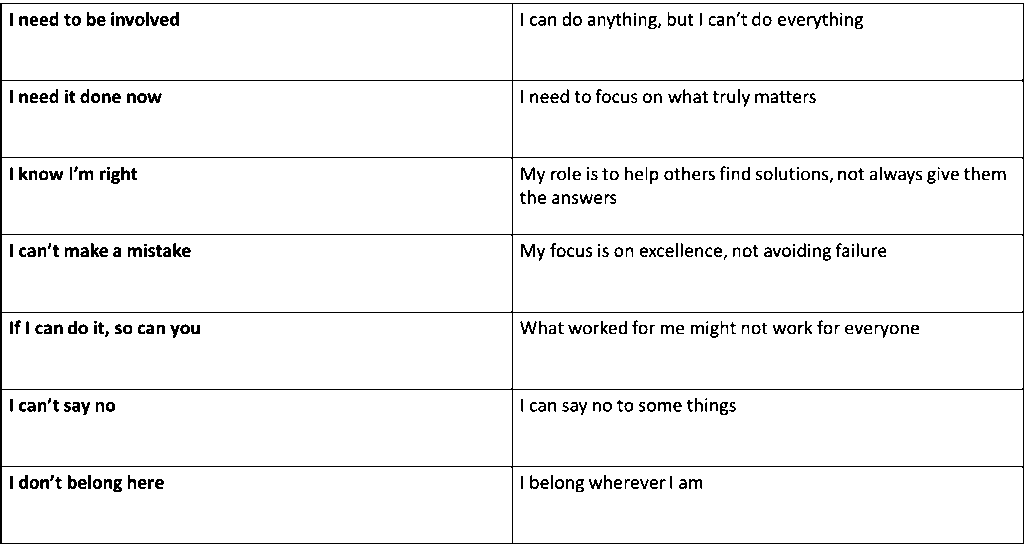
Last week, I wrote about unhelpful assumptions you make that block your path to success. On a related theme, I came across an interesting piece in the Harvard Business Review that highlights key limiting beliefs you might have that hold you back as a leader. In particular, I like the following reframes that the author, Muriel M. Wilkins, shared for reshaping unhelpful, misguided beliefs you might hold deep.
IMPLEMENTATION (one research-backed strategy, tip, or tool)
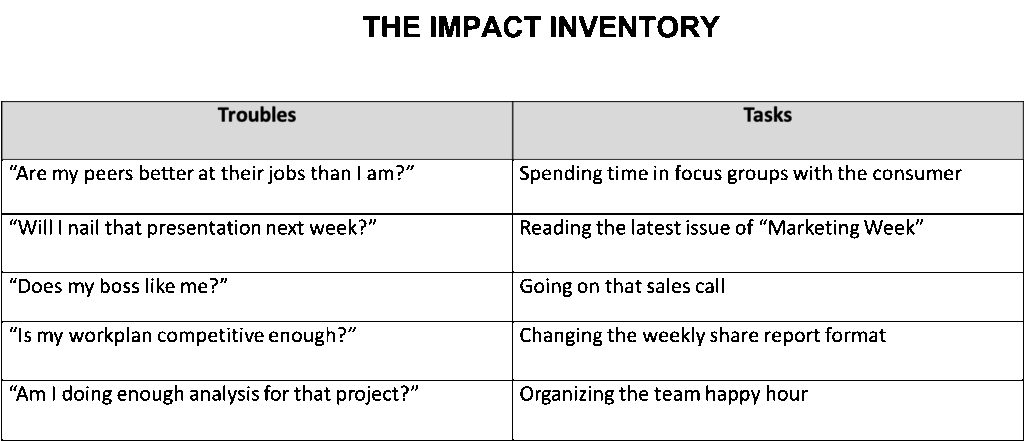
Overwhelm can arise when you pack your brain with an overload of thoughts, emotions, worries, concerns, and To-Do tasks – and you keep carrying all of it around with you. If this sounds like you, conduct an Impact Inventory. Take a piece of paper and create two columns: label one column “Troubles,” and the other, “Tasks.” Then write down everything that’s troubling (or worrying) you, and all the tasks (or projects) you have to do. Here’s a simple example below:
Feels good to just get it all out on paper, no? But here’s the even better part. Now ask yourself, “What troubles can I impact, and what tasks will make an impact (on what matters)?” Circle only those things that apply – like so:
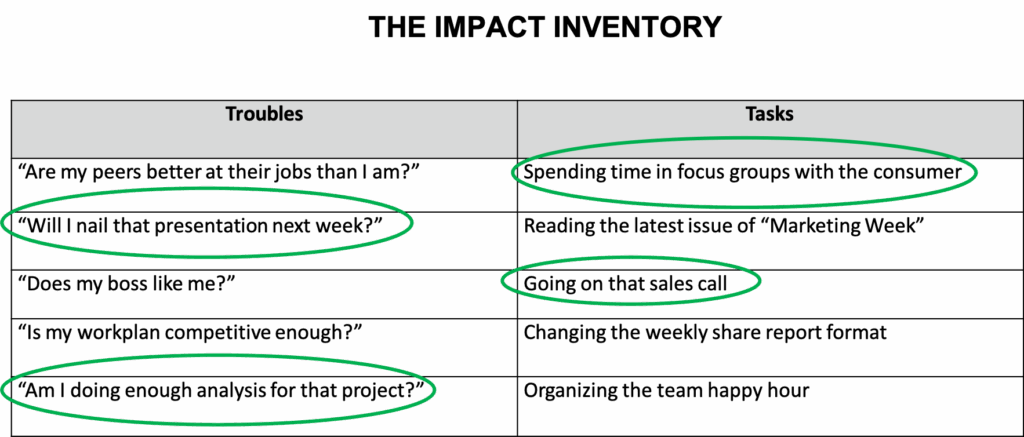
Regarding what’s troubling you, you know you can impact that presentation next week by practicing it more and spending time anticipating questions. To determine if you’ve done enough analysis, you decide to walk that Finance person through your work so far. It’s not that the other things troubling you aren’t real – you’re just choosing to focus on what you can actually impact.
On the Tasks side, you know spending time with the consumer is critical for mining insights. You know going on that sales call gives you vital training you need. It’s not that the other tasks are pointless – you’re just choosing to focus on what will actually have the biggest impact on what matters most.
And just like that, you’re more focused on worries you can do something about, and on getting the few tasks done that will make an impact on the things that matter.

Leave a Reply