INSIGHTS (on leadership/self-leadership)
Anyone looking for a job right now is likely having a tough time. In fact, it’s a historically difficult time for job hunters. That’s why I want to share two resources for helping your job search process. The first is this article from 25-year retained search consultant, Donna Svei. In it, she indicates that “next level information,” gleaned from new research that combines eye-tracking and machine learning, can dramatically increase the likelihood that your résumé will trigger an interview.
It has to do with how long the reader spends with the Experience section of your résumé – the longer the better. So, how do you increase your “dwell time” (as it’s called) here? Svei suggests the following (edited for brevity):
1. Eliminate walls of text. No more than three or four line text blocks.
2. Show your relevance immediately to draw further attention. Meaning, place your Experience block directly below your opening summary on your résumé. Have the Experience section clearly labeled, by the way, like all the sections on your résumé (Professional Experience, Education, Skills, etc.)
3. Present your Experience section using a consistent structure. And describe the scope of each role in a narrative paragraph, followed by bullet points detailing the impact you had in that job. These impact bullets should highlight what’s most important to the reader based on the job description; they shouldn’t be based solely on what you think is important to convey about yourself.
4. Provide white space. It makes your résumé easier to engage with and understand.
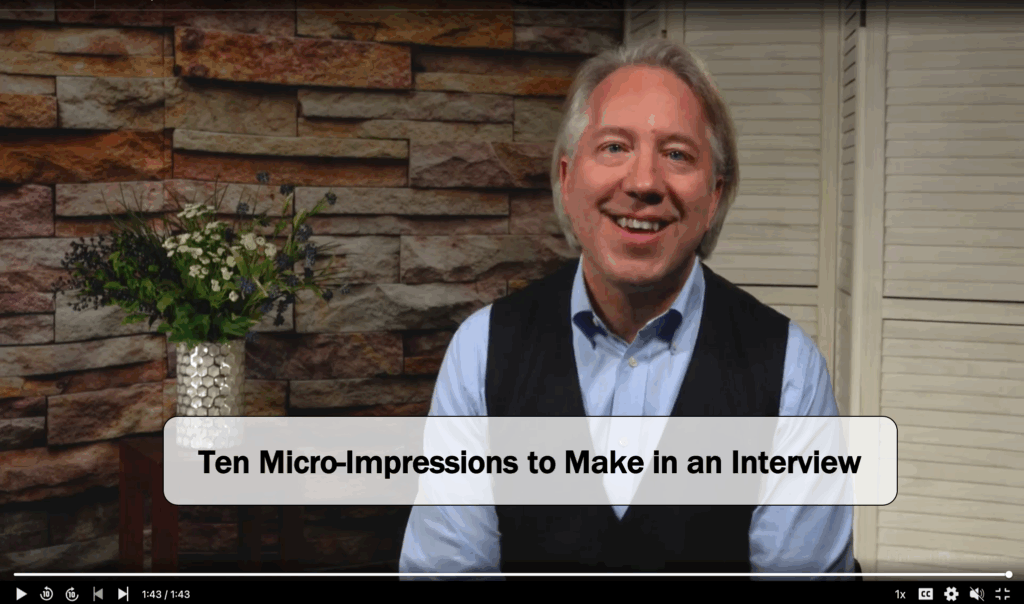
As for the second resource, check out my popular LinkedIn Learning course, Ten Micro-Impressions to Make in an Interview. If you don’t have a LinkedIn Learning subscription, I’ll be sharing the course on LinkedIn on Friday, December 5th, with a link for anyone to take it for FREE (as long as they do so within 24 hours of clicking on the link). To ensure you don’t miss this post, go to my LinkedIn home page on December 5th, and look in the Activity section to find the most recent post (with the free course link in it).
Happy job hunting!
IMPERFECTIONS (a mistake many make)
I was called in for jury duty and, I’m embarrassed to admit, I was annoyed. The county somehow has me on the “frequent flyers” list and has called me in several times. Each time I’ve gone in, filled out the paperwork, waited for half the day, and was then dismissed, my jury duty effectively over. What a waste of time, I thought after this sequence of events happened again.
Only this time, a judge came out and spoke to everyone in the holding room. He explained the following: (I’m paraphrasing as best I can from memory):
Thank you all for your service today. Now, many of you might be frustrated, feeling like you just wasted half a day. You came all the way down here, sat around, only to be dismissed. How annoying. But please understand that, in fact, you played an essential part in the justice process. As you sat waiting in this room, three floors above you, a prosecuting attorney explained to a defendant that she had a room full of potential jurors downstairs that were ready to be called into trial. She used you all as a bargaining chip to encourage compromise, or admission of guilt, or various other things intended to speed along the justice system in a productive, truthful way. So, just by showing up today, you served the court well.
That got me thinking about how often we make the mistake of underestimating the power of just showing up.
• Showing up for your child’s play, no matter how crazy things are at work.
• Showing up for your friend to be an empathetic ear.
• Showing up ready to give your best at work. All day, every day.
• Showing up for that family gathering, even though you find them exhausting at times.
Ask yourself, “What might I choose to show up for that I wouldn’t have otherwise?”
IMPLEMENTATION (one research-backed strategy, tip, or tool)
Here’s a simple but powerful tool for staying positive-minded in the face of a negative outcome.
Use the 2P Approach, which says that when you’re faced with a negative outcome, spend 50% of your energy on seeing the Possibilities in that outcome (the silver lining) and 50% on Pragmatism; on calmly, rationally dealing with the implications. 50 + 50 = 100, which means you spend 0% of your time spiraling downward and feeling overwhelmed because of that negative outcome.

Leave a Reply