
INSIGHTS (on leadership/self-leadership)
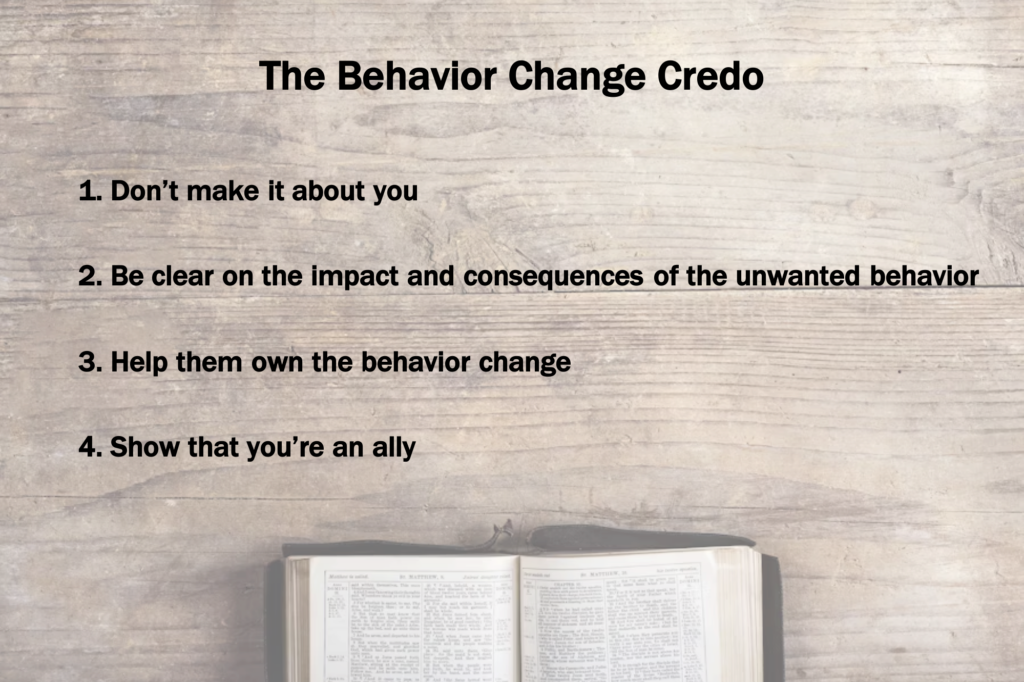
Does someone at work or in your life need to change an unhelpful behavior? To get them to do so effectively, follow the four principles of the Behavior Change Credo:
1. Don’t make it about you. For example, if you want someone to start showing up on time to meetings, don’t make it about the fact that you find tardiness personally unacceptable, as it’s a sign of a lack of discipline. The other person might think that’s a thing personal to you, and so it’s not that important. Instead, make it about their self-interest or the greater good. Tell them that being on time is critical if they want to be seen as upper management material or that the broader team can’t operate at its maximum efficiency without using every minute together wisely, which requires everyone to be on time.
2. Be clear on the impact of the negative behavior and the consequences if it continues. People won’t change if they aren’t clear that the thing you want them to change has a meaningful negative impact on those around them. Nor will they change if they don’t understand what the consequences are of not changing. In our example, they need to understand that when they’re late to a meeting, not only does it throw the agenda off, but other people start to think that it’s OK to be late too. And they need to understand that if they don’t change their tardy behavior, they won’t be considered for promotion, for instance.
3. Help them own the behavior change. Change happens when people take ownership of change. To maximize the chances that the person will own the behavior change, let them suggest exactly what they’ll change to solve the issue. Maybe you ask that continually late employee how they might change the unwanted outcome, and they come up with the idea of putting 50-minute meetings on their calendar so they have a 10-minute buffer to get to the next hour long meeting on time. You get the idea. It’s about letting them suggest how they’ll change, and if they struggle with that, helping them brainstorm options.
4. Demonstrate that you’re an ally. No one wants to talk to a critic. Everyone wants to talk to an ally. So come across as an ally by stating that you want them to succeed and that you’re willing to help them with the behavior change that’s needed. After all, pointing out that someone is missing the mark isn’t the same as helping them hit the mark.
So, follow the Behavior Change Credo and you’ll change your ability to foster behavior change, for the better.
IMPERFECTIONS (a mistake many make)
Here’s a surefire tip to help you raise your productivity and lower your stress.
Examine urgent. Meaning, don’t make the mistake of accepting urgent requests at face value. There are several things to consider:
· “Your poor planning does not constitute my emergency.” Ever heard this saying? If you suspect their thing just became your urgent thing because they didn’t plan properly, you might think differently about rewarding that behavior.
· What are the assumptions behind why it’s urgent? There might be a bad underlying assumption that made the request seem urgent, thus exposing it as not urgent after all.
· What’s the source of the urgent request? If nobody’s sure, well, that tells you something – don’t just snap to it. Find out the source. Is it a request from the boss’s boss, or higher, with heat to it? Fine, you probably just want to get into execution mode. If it’s not so obvious that you must fulfill the request urgently, there might be time to validate the urgency.
· Is there a pattern to the urgent request? Do urgent requests always come up before a standing, big quarterly meeting? Do they always accompany a visit from someone in the Executive Suite? If you discern a pattern, you can try to at least anticipate and flush out similar requests in the future. Ideally, you eliminate the requests altogether with some advance planning, or at a minimum you downgrade the urgency from DEFCON 1. If the urgent requests are constant and come from your boss, it’s time to spell out the ripple effect that attending to these requests has on other work.
IMPLEMENTATION (one research-backed strategy, tip, or tool)
Saying “no” to people when they ask you to do something can be hard. We all have at least a little people-pleasing tendency. But saying “yes” all the time leads to burnout, regret, lost focus, and many, many other maladies. Instead, try this:
Give a different “yes” to requests.
If it’s hard for you to say “no,” you can say “yes” in spirit in other ways – like having empathy for the request (but still saying “no”), providing an alternate solution, or showing support in some other way. It’s about not granting their request while still leaving the discussion with an aura of positive energy. By the way, stall in the face of the request, if necessary, to avoid rushing to the more comfortable, absolute “yes” and to buy yourself time to frame a different “yes.”




Leave a Reply