
INSIGHTS (on leadership/self-leadership)
Confidence is not the absence of doubt. It’s your ability to effectively manage your relationship with doubt, because we all experience doubt at times, no matter how confident we are. You maintain a healthy relationship with doubt (i.e., uncertainty about your ability to accomplish something) by regularly conducting doubt assessments. That is, by evaluating where you are on the Doubt Continuum:
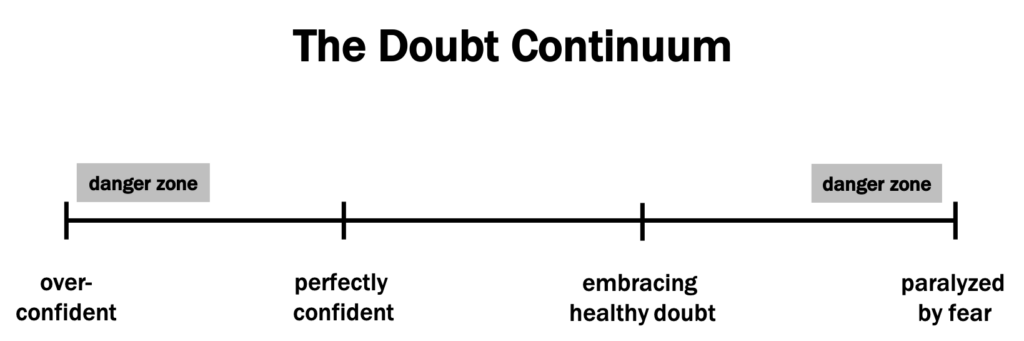
Ask yourself, “Where am I on the Doubt Continuum? Am I overconfident, perfectly confident, embracing healthy doubt, or paralyzed by fear?” The idea is to ensure you’re in neither danger zone (on the far ends of the continuum). The left-side danger zone is when you’re overconfident. Meaning, you’re not just supremely confident about the situation and your abilities, you’re overconfident to the point of gross overestimation, assuming too much, operating in a vacuum, or blowing through “red light” warning signals. On the far-right-side danger zone, you’re paralyzed by fear of failure, afraid to proceed—well past having useful healthy doubt or a little discomfort with a situation.
Now let’s look at the areas in between. If you’re perfectly confident, that means your confidence is well justified—you have enough data, practice, experience, skill, or whatever is required to feel confident about the situation, without being arrogant or dismissive. (There’s nothing wrong with extending into “superconfident” as a leader, as long as it doesn’t stretch into unwarranted, unhelpful overconfidence.)
If you’re embracing healthy doubt, you feel a little uncertain about the outcome, maybe even skeptical, but at a level that’s productive—it’s not holding you back or causing paranoia. You’re okay with not knowing everything and feel confident in your ability to learn and figure it out along the way. The doubt pushes you to work harder and smarter and focus more. Even venturing into some real discomfort is fine (that’s where the most growth happens, actually). It’s when that discomfort swells into dysfunction that trouble arises (and fear starts working against you).
Again, this is about ensuring that you’re not in either danger zone: overconfident or paralyzed by fear of failure. Let’s focus on what to do if you are.
Overconfidence: Overconfident leaders believe there’s no doubt they’re right, and won’t let doubt into the picture, by limiting further input. Instead, open up to the idea of being wrong by seeking further input (up to a point).
Paralyzed by fear of failure: To push past your fear of failure, name and reframe. Meaning, do two things. Name what you’re actually afraid of. Ask yourself, out loud, “What am I really afraid of here?” Odds are it’s not the failure itself you’re afraid of; it’s something associated with failure, like feeling shame, for example (which is quite often the case). So, name it, say it out loud. When you do, you go from a paralyzing, overarching fear, to something more concrete and finite in scope. You can then focus on it and address it with specific plans to overcome it. It thus begins to lose its power, its hold, over you.
Once you’ve named it, now reframe it. Understand that fear engages your brain in the wrong conversation. But you can change that conversation, for yourself, or anyone you’re coaching through their fear of failure. For example, consider the following reframes:
• There are only three ways to actually fail; when you quit, don’t improve, or never try.
• Failure is an event, never a person.
• Failure doesn’t happen to you, it happens for you.
• You don’t suffer when you fail, your ego does (and you/your ego aren’t the same thing).
• Your fear of failure shouldn’t scare you. It’s there to tell you that something must be worth it—or you’d be feeling nothing.
IMPERFECTIONS (a mistake many make)
It’s all too easy to spiral down into a whirl of negativity these days. So, here’s a lesson on positivity from, of all sources, an interview I conducted with a Navy bomb disposal expert. He told me of a particularly harrowing experience he had trying to defuse a mine while underwater. At one point, he realized he’d become trapped, unable to move his hands or feet. Rather than let panic take over, he thought, “I’m still breathing, so that’s good. Now what else do I have going for me?” Then he realized he could at least wiggle his fingers enough to untangle the line trapping him. Then he turned his focus to that next positive thing that would make his situation slightly better, and kept building from there.
His point was to “have cascading positivity as opposed to spiraling negativity.” He started with the good (while being realistic about the facts), which calmed him, helping him to focus on what else was good, what he could control, and what to do next.
You can too, no matter what adversity you face.
IMPLEMENTATION (one research-backed strategy, tip, or tool)
Want to challenge yourself to raise your game at work? Try the Rockstar Rule, which says to ask yourself:
“If I were replaced tomorrow by a rockstar employee, what are the first few things that rockstar would do?”
It’s effective because it forces you to set aside excuses, inhibitions, politics, the environment you work in, and so on, and to cast a critical eye on what needs to be done (or done differently) to take your performance to the next level. It encourages you to think bigger about your role and the possibilities it holds. It also helps expose weaknesses in how you approach your job or the “hard things” you’ve been avoiding.
Ask the question, and you just might become even more of a rockstar yourself.

Leave a Reply