INSIGHTS (on leadership/self-leadership)
What’s one of the best-intentioned mistakes we make that unwittingly creates more anxiety? Overscheduling. Do you pack every workday with back-to-back meetings and activity? Probably – most of us do. Deborah Vinall, a licensed mental health therapist and Doctor of Psychology, says there are many reasons we do this:
• We struggle to set boundaries
• We want to please others, or keep up with others
• We want to feel busy, worthy, and important
• We have a sense of obligation and/or guilt
• We don’t want to miss out on anything
Whatever the reason, it leads to burnout and anxiety, not the success we think it does when we do it. I can tell you from personal experience, I’ve learned to hold some downtime on my calendar each week so that I can react to new opportunities that arise in my business or so I have capacity to adapt to something in my workflow that needs to change. In fact, productivity expert and author Donna McGeorge says leaders should focus much more on what she calls adaptive capacity, setting aside 15% of their time as “flex” time each week.
Pick how much of a buffer you want to plan into your calendar – but do pick up the habit. It’s time to replace FOMO with WOTTA (Windows Of Time To Adjust).
IMPERFECTIONS (a mistake many make)
Here’s what research shows are the three biggest misconceptions about productivity. Avoid them if you want to be maximally productive:
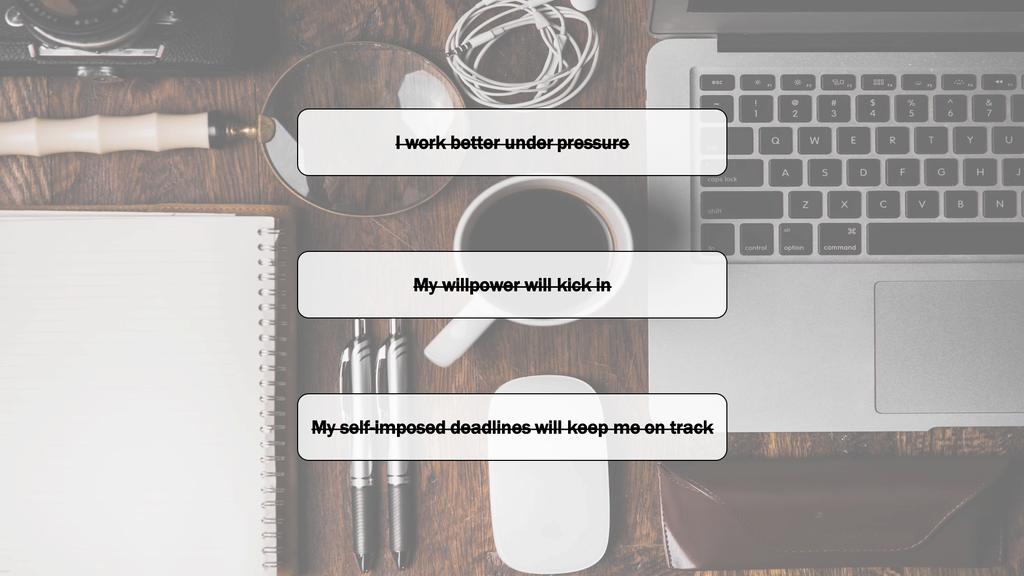
“I work better under pressure.” Research simply doesn’t support this. In fact, it shows the opposite. Stress actually makes things much tougher on your brain, clogging it up and interfering with the ability to learn and translate ideas into meaningful information. In study after study, people under stress have repeatedly been shown to do more error-prone work.
“My willpower will kick in.” I know you want to believe that you’ll get started on that task this weekend, or that you’ll be able to resist watching your favorite show tonight so you can finish your presentation. Unfortunately, studies show that our willpower isn’t as strong as we think it is and that it can be depleted surprisingly quickly. In fact, we often subconsciously avoid committing to long-term goals because we know deep down that when we first encounter a setback, our willpower will quickly run out and we’ll end up bailing. Think of that exercise routine you promised yourself you’d stick to. Things were going well until you missed two days in a row, then bam! Back to the usual.
Even when we feel truly committed, we consistently believe that we have more restraint than we actually possess. Researchers from Northwestern’s Kellogg School of Management conducted experiments on a range of temptations, including greed, drug use, and arousal, and found across the board that personal restraint levels were continually overestimated, leading to poor choices.
“My self-imposed deadlines will keep me on track.” Studies show the idea of setting deadlines for yourself isn’t as effective as you think it is. Researchers gave word jumbles to different groups of students, with a promise of a cash payment if they completed the jumble on time (and nothing if they didn’t). Groups were given either one final deadline, a series of interim deadlines, or allowed to impose their own deadline. The group that imposed their own deadline was heavy with self-reported procrastinators who said they were using the opportunity for a self-imposed deadline to practice addressing their procrastination. It didn’t matter though — this group ultimately ended up having the lowest completion rate of any group. In reality, despite the self-imposed deadlines, they started the word jumbles too late, found out it was harder than they thought, and that they didn’t have enough time to complete the work, and so bailed.
By the way, the group that did the best on task completion rate was the one working with a series of interim deadlines. This is consistent with other research that indicates setting such deadlines externally, like with a boss or with friends, is the most effective way to encourage adherence to a deadline.
IMPLEMENTATION (one research-backed strategy, tip, or tool)
In the last issue, I asked people to share a simple mantra that has served as a guidepost in their life. Here are some of my favorite responses:
“Wherever you are, be there.”
“A little grace, curiosity, and willingness to understand another perspective can go a long way.”
“Do one kind, unexpected thing for someone each day. Focusing on others helps with your own worries.”
“No masterpiece comes from a lazy artist.”
“If at first you don’t succeed, ask yourself if achieving it is really success”
“I am bigger than my mistakes and fears”

Leave a Reply