INSIGHTS (on leadership/self-leadership)
Research from Princeton University shows that someone you’ve just met will decide if you’re trustworthy or not in a 10th of a second.
The researchers conducted five experiments seeking to discern first impressions one person would have of another regarding not only trustworthiness, but attractiveness, likability, competence, and aggressiveness as well. The initial impressions generated after a 10th of a second did not vary from impressions generated among those who were free to take all the time they needed to form an impression.
Whoa.
So how can you possibly mold a perception that you’re trustworthy in the blink of an eye?
Body language.
Here’s a powerful mnemonic to help you ASSURE someone that you’re trustworthy (using body lingo).
Awareness: That is, of hand and head movements. Pointing at someone sends an overly aggressive signal, as does crossing arms and “burying” the hands. In fact, body language experts recommend you show your palms as much as possible. It signals peaceful intent and that you’re not hiding anything.
As for the head, tilting it indicates a willingness to adopt a more vulnerable position. The tilted head was a favorite technique used by President Obama when debating an opponent–it engendered less hostility and resistance.
Smile: A genuine smile can relax and even disarm. Also, when you’re smiling, it’s difficult to have a furrowed brow, which can send an unintended signal of a lack of acceptance. We all have enough negative ions in our life. Being a positive one right from the get-go draws people to you and enhances their desire to trust you (again, as long as it’s a genuine smile).
Signs of absorption: You’re far more trustworthy when you show you’re listening. So, send signals that you’re listening, absorbing, and considering what the other person is saying. This includes nodding (without overdoing it, which can be distracting), bringing your hands to your chin as a sign of deep consideration, and showing empathy in your facial expressions when warranted. It’s about subtly creating a human connection. It’s the tactic I’ve used most to build trust as a leader of very diverse, expansive organizations.
Uplift: This is related to smiling but is broader. In general, approach the others as if you want to uplift them in some way. Even intently listening and using appropriate facial expressions when someone is angry, distracted, or relaying horrible news can be uplifting in that the other person feels heard. An uplifting mindset triggers instinctive things like standing upright, leaning forward, showing energy, mindfully choosing words, and yes, smiling and listening.
Reflecting: Mirroring another’s facial expressions, arm position, or gestures helps create a sense of commonality and connection. It’s not about suddenly morphing into someone you’re not. It’s about paying attention to the movements and intricacies of others’ communication and reflecting it back so that they can subconsciously see more of themselves in you, which inherently builds trust.
Eye contact: Research shows people who fail to maintain eye contact during discussion are seen as more deceptive and less sincere. On the other side of the coin, research shows those who look others directly in the eye are much more believable.
IMPERFECTIONS (a mistake many make)
Let’s continue with this week’s theme of trust. One of the quickest ways to lose trust as a leader is to fail to be transparent. But exactly how should you be transparent?
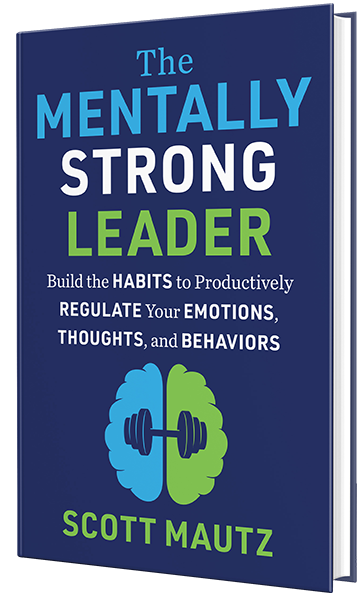
As I share in The Mentally Strong Leader, there are five key ways to show up as transparent, in a manner that people can clearly see. I sum them up in a visual I call “The Window of Transparency.”
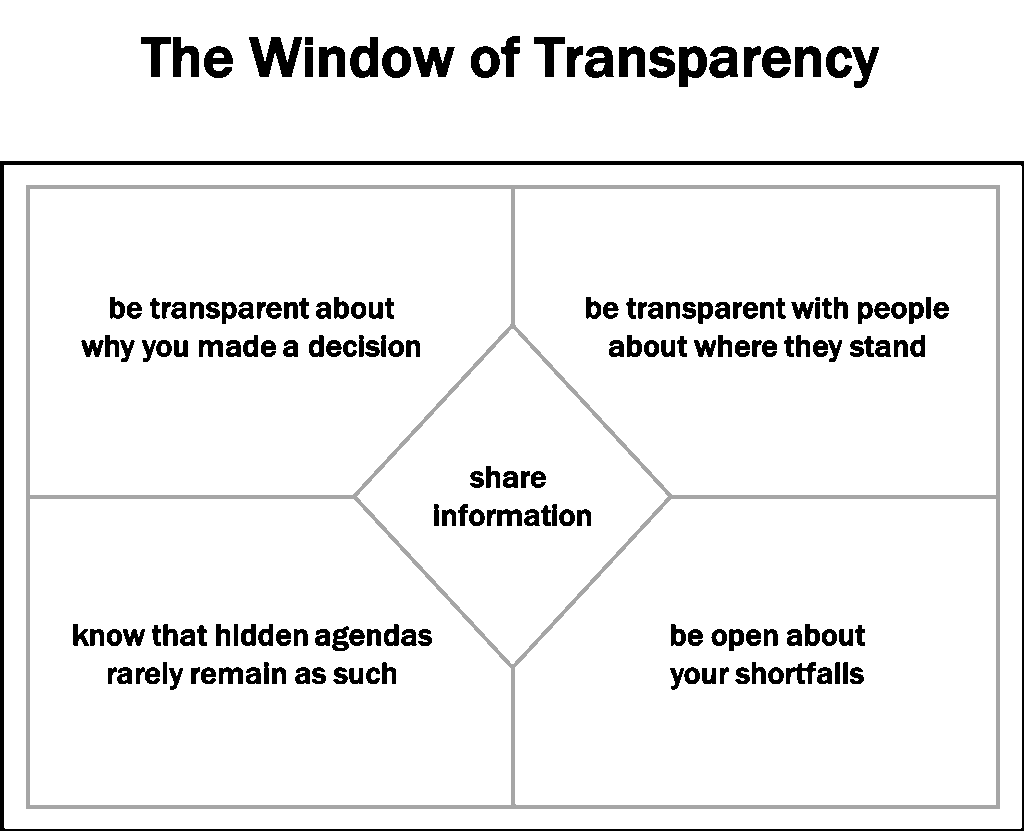
Failing on any of these window “panes” will cause you pain, so let’s go through each, starting in the center.
Share information. Unfortunately, some leaders believe the more information they withhold, the greater their power. But they aren’t exerting control; they’re just keeping people from doing their jobs and creating distrust (if their information withholding is discovered). They’re even hurting creativity, as research shows hoarding information denies people stimulus that helps them better create, and keeps the hoarder working in a vacuum.
Be transparent about why you made a decision. When it comes to explaining your decisions, don’t be evasive, don’t worry about hurting feelings (but be respectful), and don’t hide underlying motivations; those motivations have a way of eventually showing themselves.
Be transparent with people about where they stand. On the positive side here, don’t hold back telling someone how good they are because of whatever imagined downside to doing so that you’re conjuring. On the more difficult side, it’s never easy to tell someone something they won’t enjoy hearing about their performance, or how they’re perceived. But it’s a core responsibility as a leader; you owe them the truth, and they’ll be better off for it in the long run. You’d want to know where you stand, right? It might sting in the moment, but if you communicate the message with compassion, respect, and a clear desire to be of service, they’ll be better able to hear, process, and ultimately accept, the message. They’ll respect that you’re willing to share the good and the “bad.”
Be open about your shortfalls. Be honest about what you’re not good at, ask for help improving on that front, and surround yourself with people who offset your weaknesses. Don’t pretend to know everything and be everything. For example, say you share you’re not good at noticing when people are feeling burnout. You ask your team to help by identifying when they are (feeling burnout), and you ask your HR partner to do periodic sensing to help you assess when it’s happening. Everybody wins from your vulnerability. Yes, even you.
Know that hidden agendas rarely remain as such. Having a hidden agenda, or a desire to accomplish something through manipulation (that’s different than the agenda on the table), usually doesn’t stay hidden. It only takes one little slip for the true intent of someone’s actions to come out. And that one slip sends a toxic message that can undo the power of a thousand other positive messages sent beforehand. Don’t play this game. The most toxic organization I’ve ever been a part of had a leader who always had hidden agendas – you were just waiting for the thing he really wanted to be revealed. Most often, eventually, it was. Not surprisingly, commitment to him was non–existent.
IMPLEMENTATION (one research-backed strategy, tip, or tool)
One last dip in the trust well.
One of the most important things a leader can do for a team’s confidence is to trust them. Most of you intuitively know that.
But you might underestimate the importance of trusting loudly, as Stanford psychology professor Jamil Zaki recently termed it in Harvard Business Review.
Trusting loudly is about being intentional to openly voice your confidence and trust in others, and to back up that belief with specific reasons why you trust them.
If someone is starting a new position, express your belief in them and tell them why you believe they’ll succeed. When your team is facing a tough obstacle, voice your confidence in them and express why you know they’ll get through it. When you empower someone with new responsibilities, explain why you know they’ll succeed and why you felt comfortable delegating to them in the first place.
Bottom line here is that when you want to demonstrate deep trust, don’t whisper in a well.


Leave a Reply