
INSIGHTS (on leadership/self-leadership)
Few things are more difficult at work than working with someone difficult. It can change the entire outlook of your day, or even your job.
So, if you have a difficult co-worker in your life, before you next interact with them, I encourage you to remember the following singular sentence:
We all fear something, love something, have lost something.
Let’s examine each element.
We all fear something. Fear explains so much of undesirable human behavior. Perhaps that difficult co-worker really fears failure, criticism, change, or rejection (yes, even your rejection of them). The problem is that fear engages our brain in the wrong conversation and distorts reality. It causes us to act in ways we don’t intend or are unaware of. Heck, neuroscience has proven that our fear of failure literally shuts down the part of our brain responsible for risk-taking and exploration. Maybe this is what’s behind that conservative co-worker’s behavior that’s driving you nuts, for example.
We all love something. Here’s why this element matters. Everyone is loved by someone and has the capacity to love. So even that miserable co-worker is loved by somebody, even if it’s not you. To be loved requires qualities worth loving. Might you consider that in the case of your co-worker? Might you expand your own capacity to “love” and begin to look for what others see in that co-worker? Could you try to see them for what they are that is wonderful (to someone at least), rather than for what they aren’t (according to your own narrowed worldview)?
We all have lost something. Maybe that co-worker has lost their dignity, support, sense of confidence, or career momentum (to name just a few culprits). Maybe they’ve recently lost someone important to them in their life. Might you consider all of this and approach that co-worker with compassion?Compassion is the underpinning of community, and worth every ounce of energy you can invest. It can help you change relationships.
So, yes. We all fear something, love something, have lost something. Now add to the list, have repaired something.
IMPERFECTIONS (a mistake many make)
How do you avoid living with regrets? It’s something no one wants.
By not avoiding them.
Huh?
I’ll explain. Hospice doctor Jordan Grumet spends many hours listening to people’s last words. They’re often filled with regrets about not taking a risk, not spending enough time with friends, not living a life true to themselves instead of what others expected of them, and so on. Through his experiences, shared here, he has discovered the best way to avoid passing from this earth without harboring numerous regrets:
Be intentional about facing your regrets head-on. Resist the temptation to avoid thinking about them, like most of us do.
As Inc.com columnist Jessica Stillman pointed out, psychology studies show that regrets aren’t made less painful by refusing to think about them. The pain subsides when you use the regrets you currently have to guide you towards what has to change about your life.
In other words, don’t avoid thinking about the fact that you’ve lost touch with a dear old friend; reach out and connect with them again. Don’t stuff it down deep inside that you never learned to play an instrument like you dreamed of; sign up for piano lessons.
To help you face your regrets head-on, Dr. Grumet offers a one-question “regret test.” Periodically ask yourself:
If I were to die tomorrow, what would I regret not having the time, energy, or courage to have done?
So, face your regrets head-on. You won’t regret it.
IMPLEMENTATION (one research-backed strategy, tip, or tool)
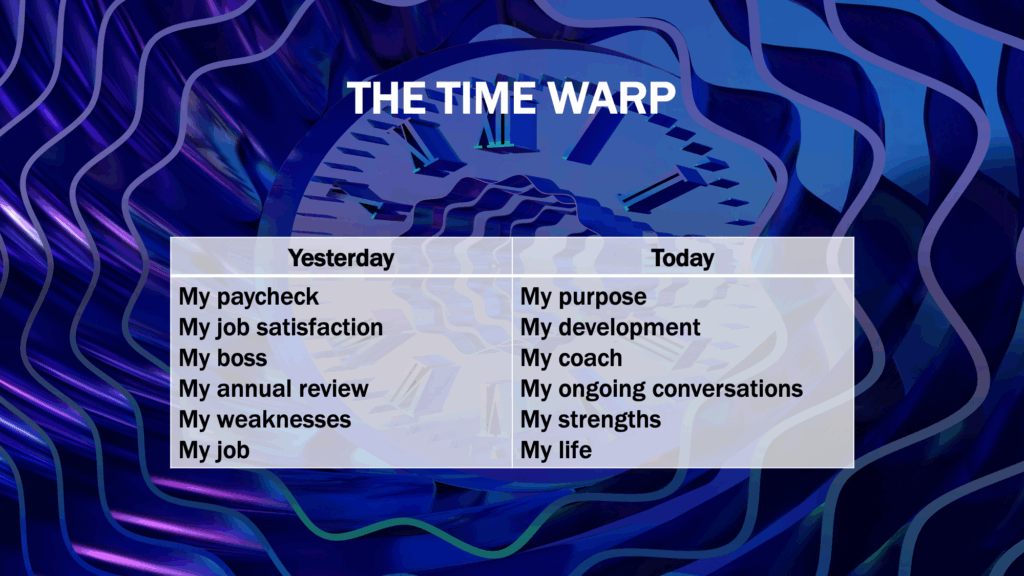
It’s easy to focus on the wrong things at work, to fall into outdated definitions of what matters most in the workplace. Here’s a simple tool I call the Time Warp. It’s inspired by work from Gallup, and reminds you of what mattered most in the workplace of yesteryear, and where your focus should lie in today’s work world.



Leave a Reply