INSIGHTS (on leadership/self-leadership)
Micromanaging crushes souls, not goals. If you tend to do this to others from time to time, or you know someone who does, try (or share) what follows to help break the pattern of micromanagement.
Commit that when you engage with your employees, your focus will be on following three new “rules of engagement.” You will:
1. Check-in vs. check-up. Checking in is about seeing how people are doing, ensuring that all goes well. That’s good. Checking up is oversight. Not so good. Do you have to follow up on details sometimes and ensure progress is being made? Of course. This is about being intentional to make more of your interactions reflections of your care and concern vs. your corralling.
2. Conduct inquiries vs. inquisitions. When you conduct inquiries, you’re discerning how you can be of help. When you conduct inquisitions, you’re in inspection mode. Inspection is comfort food for micromanagers.
3. Focus on improving vs. proving. Micromanagers want their teams to prove they’re doing the work, to prove they’re on the right track. Macromanagers focus their interactions more on helping people learn, grow, and become better versions of themselves.
IMPERFECTIONS (a mistake many make)
Sometimes we make mistakes that keep us from being happy. Self-inflicted wounds, if you will. But sometimes, we just get caught in unhappiness traps. I interviewed Dr. Annie McKee from the University of Pennsylvania a while back (she’s the author of How to be Happy at Work) about this topic. She shared the five biggest unhappiness traps we fall into, and how to avoid them.
1. The should trap. McKee told me that many U Penn seniors reported hating their internships, yet if offered a job, they’d take it. It’s an example of doing something you think you should because of the prestige or expectations. You’ve probably met (or may be) a person several decades into their career who is still falling victim to the “shoulds.”
To avoid this trap, McKee says it’s about being intentional with decisions you’re about to make; ask yourself, are you deciding based on a “should” or “want to”? For example, are you considering taking that job or moving to that city because it’s what you should do, or because it’s what you want to do? Of course, sometimes you have to follow the shoulds because of constraints you have. This is just about not defaulting to letting “should” drive everything.
2. The overwork trap. Inundation is the new black. McKee reiterated how easy it is to work 24-7 if we wanted to. McKee says this about the solve:
“It’s simple but so hard. Turn the phone off. Look at your calendar and ask, what do I want to do, what must I do, and what has ended up on my calendar because someone thinks it should be there (these things sap our energy). Every day at work build in time for quiet reflection. Take a lunch break without working through it.”
3. The ambition trap. “Ambition is great until it’s not,” says McKee. Reaching beyond and stretching ourselves is great. But many become trapped by their own ambition; all they do is go for goal after goal after goal. They don’t enjoy it; it’s the chase they focus on, which soon feels empty.
So, first, figure out if your ambition is healthy or not. If you don’t enjoy achieving your goals or are hyper-competitive with your peers, you’re likely in this trap. If so, stop thinking about short-term goals/ the next promotion and start thinking about what you want in life. Where do you want to be 5-10 years from now? What do you want said about you as a person? Short-term goals don’t feed you like your long-term vision.
4. The money trap. This one’s related to ambition, and you know the drill. People stay in bad jobs for a paycheck, take promotions they didn’t want for more money, or endure misery holding out for the next pay raise. But it doesn’t feed your soul, and most often it’s never enough.So what to do?
Obviously, it starts with getting yourself financially unstuck so you don’t have to stay in a job that’s making you unhappy just for the paycheck. You already know this. What’s insightful and interesting, however, is people’s definition of being “financially stuck.” Often, in honest conversation, you learn that they’re actually financially stable by definition, but in truth, they want more than they truly need. They may be unwilling to lower any standard of living element, blind to the alternative (that deeper happiness that could be enabled as a result). The key here is to neutralize money as a motivator in your life so you can focus on things that will bring true happiness.
5. The helplessness trap. This one’s the most dangerous of all, according to McKee. When you feel disempowered, like a victim of your circumstances, it’s a dangerous place to be as it’s hard to take bold steps. If you used to be glass-half-full or now find yourself hanging out and conspiring with cynics, you may be in this trap.
Recognize when you’re starting to complain, blame, or go negative as a pattern. Enroll friends to not play into this with you, accept responsibility for what’s gone wrong, and take charge by mapping out the life you want versus the one you’re living.
Net, there are enough traps in life to get caught in. Just get caught up in crafting your happiest life.
IMPLEMENTATION (one research-backed strategy, tip, or tool)
Want to get better at prioritizing your work? Try the PIE method (PIE being an acronym, as you’ll see). Here’s how it works.
Assign each piece of work you’re evaluating a score, from 1 to 10, on three factors:
Potential, Impact, and Effort.
Potential is an estimate for how valuable that work could eventually be for achieving the objectives and goals (10 being the highest potential).
Impact is an estimate for how immediately valuable it is to complete that work (10 being the greatest impact).
Effort estimates how complicated or easy it is to do (10 being the easiest).
The average across all three factors is the PIE score, and work with the highest PIE score gets prioritized. For example, a product development team evaluates three pieces of work, assigning the following PIE scores:
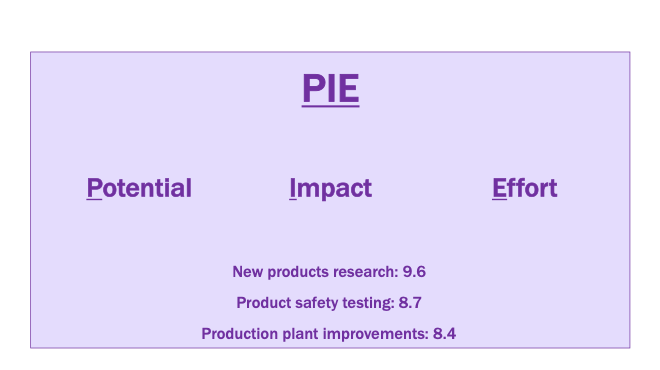
New products research is the clear number one priority. You get the idea.
Note that using this method also forces you to ask, “Is the juice worth the squeeze?” Meaning, if the work takes a lot of effort to complete, you should ask if it’s worth the impact and potential it represents.

Leave a Reply