INSIGHTS (on leadership/self-leadership)
There’s a story I tell in my keynote, “How to Leave a Legacy at Work and in Life,” that I’ll share the gist of here – it gets at the need to be intentional about how you live your life:
There was once a man named Alfred; a very wealthy Swedish chemist who made a fortune by inventing dynamite and other explosives that were essentially the weapons of mass destruction of his time. Later in his life, in 1889, his brother Ludwig was killed (ironically in an explosion at one of Alfred’s very own dynamite factories). A local newspaper showed up to report on the tragedy but they had their facts wrong. They mistakenly believed that Alfred had died, not his brother, and so wrote their story accordingly.
The very next day Alfred had the strangest of human experiences; he was able to read his own obituary, which would have been disturbing enough. The problem was that Alfred didn’t like what it said. The paper called Alfred “The Merchant of Death,” a man who grew rich off his inventions that were used to kill people in unprecedented quantities. Alfred faced the horrible realization of what he’d be remembered for, what his legacy was, and he knew he couldn’t stand for it. He had to change it. From that point forward, he committed the rest of his life to promoting and rewarding acts that honored and benefitted humanity instead of obliterating it.
Thus, Alfred Nobel established the Nobel Peace Prize – and the world will never be the same for it.
Warren Buffett mentioned this same historical occurrence recently in his last letter to shareholders to make this point- the same point I make in my keynote:
“Don’t count on a newsroom mix-up: Decide what you would like your obituary to say and live the life to deserve it.”
IMPERFECTIONS (a mistake many make)
Here’s some tough love, if I may (that I also need to give myself from time to time). Sometimes, feeling overwhelmed at work (or in life) is of your own doing – because of unhelpful assumptions you make that keep you stuck in unproductive behaviors that feed a sense of overwhelm.
For example, do any of these sound familiar?
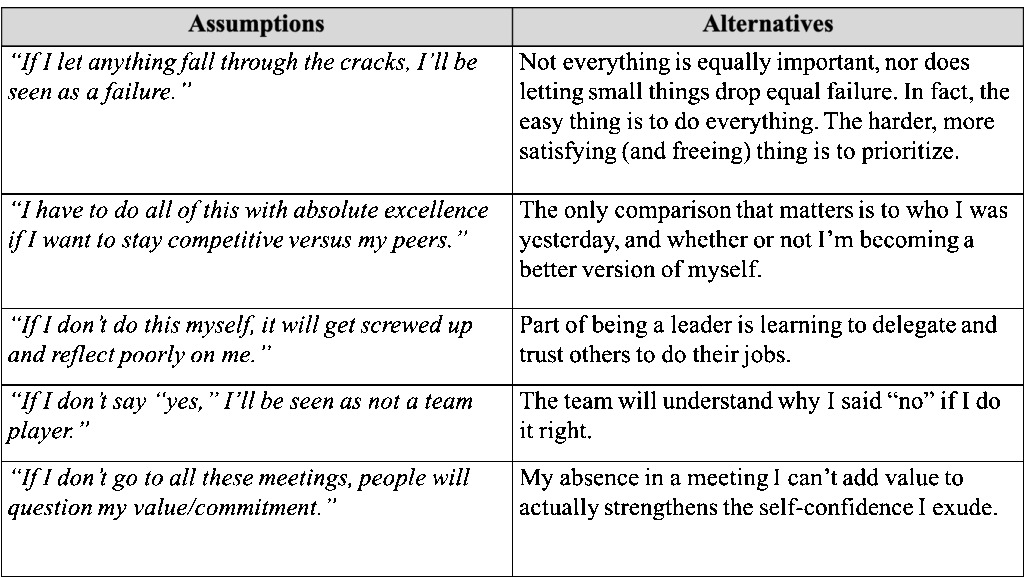
· “If I let anything fall through the cracks, I’ll be seen as a failure.”
· “I have to do all of this with excellence if I want to stay competitive versus my peers.”
· “If I don’t do this myself, it will get screwed up and reflect poorly on me.”
· “If I don’t say, ‘yes,’ I’ll be perceived as not a team player.”
· “If I don’t go to all these meetings, people will question my value/commitment.”
These are all toxic assumptions, stories we tell ourselves, that, by default, will fuel a sense of overwhelm. Instead, try this. Get a piece of paper, and label it with two columns, one being “Assumptions,” (the assumptions you’re making that you suspect might be contributing to your feeling of overwhelm). The other is, “Alternatives,” (alternative ways you could choose to see your situation). Here’s how this might look:
By the way, while listing your assumptions, name any underlying, limiting beliefs you have that are coming into play. For example, maybe you’re assuming you can’t let anything fall through the cracks because the underlying belief is that you’re a failure, or that you don’t belong in your role, and one mistake will reveal you as a fraud. Name that unhelpful belief, and say it out loud: “I believe I’m a fraud.” When you do this, your instincts kick in to challenge the statement immediately; you can then pinpoint what to do to prove it untrue. And so, the unhelpful belief begins to lose its power over you.
IMPLEMENTATION (one research-backed strategy, tip, or tool)
This week’s implementation tip is just one word, essential especially for leaders:
Over-communicate.
I’ve talked and written about the need for this (a lot). Here’s how author Dan Pink put it:
Think you’re communicating enough as a leader? Think again. New research from Stanford found that under-communication is nearly 10x more likely to be criticized than over-communication—and it comes at a steep cost. Researchers analyzed 2,717 real-world leadership assessments. What stood out? Leaders weren’t usually criticized for being negative…they were overwhelmingly called out for not saying enough. Silence isn’t neutral. It’s damaging.
In follow-up studies, employees viewed under-communicative leaders as less empathetic, competent, and trustworthy. And it didn’t stop at perception. When employees felt their leaders didn’t communicate enough—or failed to meet their communication preferences—they rated them lower on both empathy and leadership ability.
The fix is to over-communicate. Even if it feels repetitive. Even if you think you’ve said it already. Say it again. Because clarity builds confidence. This isn’t about creating noise—it’s about building alignment. Great leaders ask:
“Did I say it clearly? Did I say it often enough? Does my team feel informed—not confused?”
Bottom line: Your silence speaks louder than you think. When in doubt, over-communicate. It’s not annoying—it’s leadership.

Leave a Reply