INSIGHTS (on leadership/self-leadership)
As I’ve pointed out in my book, The Mentally Strong Leader, mental strength is the leadership superpower of our times. Resilience is no small part of mental strength. We all know we need to be more resilient, but here’s the thing.
It’s hard.
Here are three tips from sports psychologists to help you be more resilient, ones you might not have heard before, all in line with what I discuss in my book.
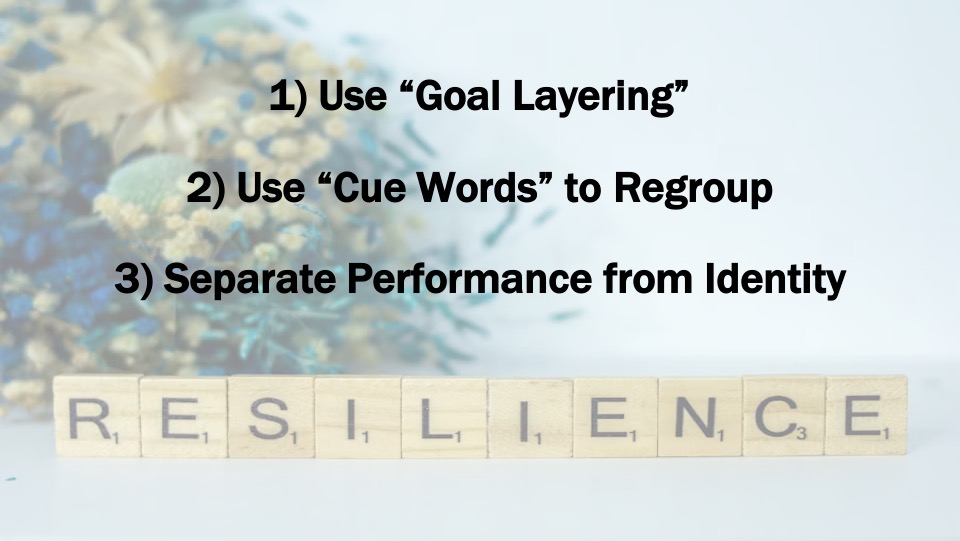
1) Use “Goal Layering.”
In other words, don’t lock into one big overarching goal only. For example, as Dr. Carla Meijen, a sports psychologist, says, “Try coming up with a dream goal, a silver goal, and a bare minimum goal. This allows you to regain control and make adjustments, rather than fixating on the big goal that you didn’t accomplish.”
2) Use “Cue Words” to Regroup.
Andrew M. Lane, the researcher behind a massive study on athletes’ use of self-talk, and a professor of sport and exercise psychology at the University of Wolverhampton, says that cue words are reminders, like “stay balanced” or “shake it off.” They help keep the athlete focused and prevent them from spiraling when something doesn’t go as planned. Athletes can even create physical cues, like a swimmer flicking the water off their goggles after a bad lap.
You can do the same at the office. For example, after a bad meeting, you shake your hands vigorously and remind yourself, “shake it off.” The idea is to create signals for your brain and body that it’s time to move forward or pivot.
3) Separate Your Performance from Your Identity.
It’s an easy trap to fall into; you tie your worth to your outcome. It helps to fall in love with the process rather than the outcome, and to remember that you’re more than any one mistake, or even a collection of mistakes, you make.
IMPERFECTIONS (a mistake many make)
There’s common advice that turns out not to be the best; you may even have made the mistake of following it verbatim. “Never assume you’re the smartest person in the room.” Doing so keeps you humble and hungry, the thinking goes. But new Apple CEO, John Ternus, has a different take on this trope. As he said in a commencement ceremony at his alma mater, UPenn:
“Always assume you’re as smart as anyone else in the room, but never assume that you know as much as they do. With this mindset, you’ll find the confidence you need to push forward, but more importantly, the humility to ask questions and learn.”
There’s a big difference between being intelligent and being informed. This is fantastic advice that can even serve as a model for your entire leadership approach. In fact, in some circles, people call it the “John Ternus Rule.” I think it’s brilliant because it bolsters your self-confidence, deflates any imposter syndrome you’re experiencing, AND keeps you “humble and hungry.”
So, be both intelligent and informed by adopting it into your leadership approach.
IMPLEMENTATION (one research-backed strategy, tip, or tool)
Want to stay more present in the moment? The next time you catch your mind wandering, remember to get out of your head and into your body. In that moment of mental drift, pause and focus on your breathing. As you breathe in, say to yourself, “I am here.” As you breathe out, say, “This is now.” Then, after a few of these intentional breaths, engage the 5-4-3-2-1 habit. That’s where you pause again and name:
- 5 things you can see
- 4 things you can touch
- 3 sounds you can hear
- 2 things you can smell, and
- 1 thing you can taste (if possible)
Doing so re-grounds you in what’s happening right in front of you, in the here and now. It helps quiet your mind and heightens your sensitivity to immediate stimuli rather than distant thoughts. With this re-centering, you can then re-engage in the present moment more fully.

Leave a Reply