INSIGHTS on leadership/self-leadership)
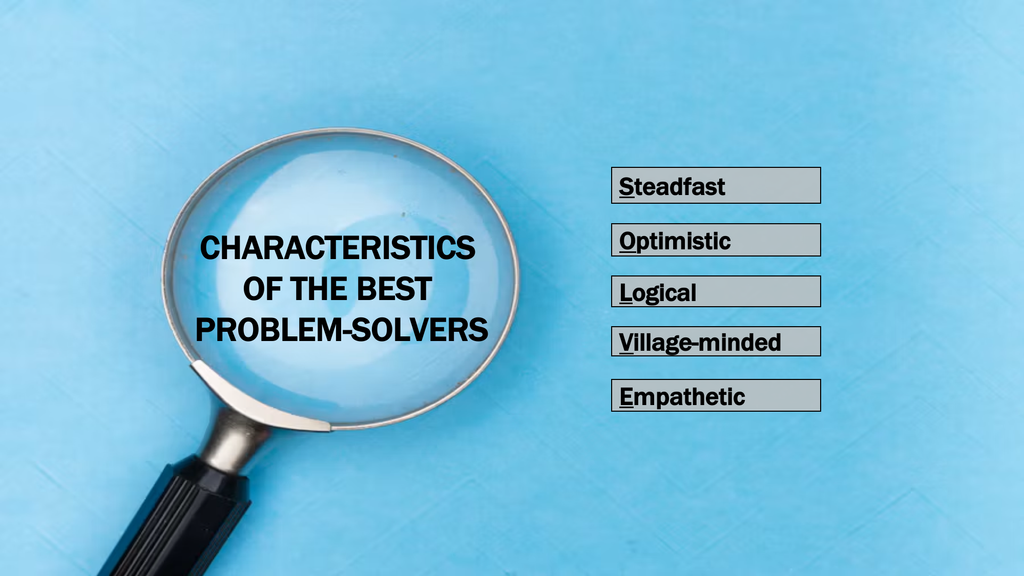
In conducting research for my book, The Mentally Strong Leader, I asked 3,000 executives an eye-opening question – “Thinking of the best problem-solvers you’ve worked with, what characteristics did they embody?” 88% of respondents listed the same five attributes, captured here in a handy, appropriate acronym, SOLVE. If you want to be a great problem-solver, make a habit of checking yourself against these 5 attributes. Are you showing up as:
Steadfast, Optimistic, Logical, Village-minded, and Empathetic.
I’ll explain each.
Steadfast. Great problem-solvers are persistent. They know it takes hard work, commitment, and perseverance, even when the solution is elusive. They maintain a steady passion for solving the problem, knowing that the easiest solution is rarely the best solution. They keep everyone’s energy and commitment up along the way. For example, one respondent described a leader charged with finding a solution for remaking the company’s entire supply chain, without ever disrupting customer service. It took a grueling 18 months to find a solution, during which the leader constantly encouraged the team as they went. It worked. Problem solved, employees proud.
Optimistic. Solving problems is hard enough. So great problem solvers approach it with optimism, a belief that everything is “figureoutable,” as author Marie Forleo says. In fact, optimism is often a self-fulfilling prophecy. Psychologist Richard Wiseman illustrated this in interesting research involving two people, one with an optimistic outlook, and one who was self-described as “pessimistic and unlucky.” He created two chance opportunities by placing money on a sidewalk, and by placing a well-connected businessman in a coffee shop, ready to strike up a conversation. The optimistic respondent spotted the money and picked it up, and engaged in conversation with the well-connected businessman, leading to more positive outcomes. The second respondent (self-described as “unlucky”), stepped right over the money without seeing it, and kept to herself in the coffee shop.
Logical. Great problem-solvers logically analyze data, looking for patterns or inconsistencies. They see problems as puzzles to be solved. They don’t get swayed by emotion, staying objective, rational and cool-headed. That’s not to say logic limits the bigness of their thinking, passion, or excitement about an idea; they just don’t let emotion, or ego, skew the way they see the problem, or solution. And that’s not to say dry logic replaces curiosity – just the opposite, the two work together. Inquisitiveness and a willingness to try new ideas are coupled with reflection and sound implementation.
Village-minded. Great problem-solvers are collaborative, knowing that it takes a village to solve a problem, a united, interdependent team with a clear mission. For example, one of the best problem-solvers I ever worked with had a compelling tactic. In times of adversity, that required intense problem-solving, she’d start off every team meeting with the same sentence: “None of us working alone, are stronger than everyone working together.”
Empathetic. Solving a problem requires understanding the people affected by the problem, and the solution. Great problem-solvers take the time, and show the interest, to listen well, comprehend the nature of the problem, and relate, so they can implement a thoughtful solution.
So, make a habit to measure yourself against the SOLVE acronym, and you’ll measure up to any challenge!
IMPERFECTIONS (a mistake many make)
Developing the right mindset to be confident is hard enough. You don’t need myths about confidence undermining your ability to achieve it. Especially not the five most undermining misconceptions about what it takes to be confident. Don’t fall for these five myths:
Myth #1: You’re born confident. Sure, confidence comes more naturally to some than others. But to think it’s a trait you’re either born with or not, is simply not true. Confidence is a habit you build, by incorporating practices of highly confident people.
I’ve measured the confidence levels of hundreds of people, before, and after, using confidence building tools I give them, and I see dramatic increases in reported self-confidence. Confidence doesn’t come when you’re put into this world, it comes from putting in the work.
Myth #2: Confidence comes from huge success. Of course, a big achievement makes you feel more confident. But the science couldn’t be clearer – focusing on smaller goals is a far more efficient, reliable way to increase your confidence. As a study of top swimmers showed, the athletes that focused on small wins, progressing towards their goal in small increments, enhanced both their skills, and confidence in their abilities, which lead to more winning.
It’s not just for top athletes though. In one study, 91% of people who focused on smaller goals, said it increased, or greatly increased, their confidence. They cited the momentum, energy and conviction it gave them to achieve the next, bigger goal, while their confidence increased steadily along the way.
Myth #3: Confident people are confident all the time. It’s easy to assume this because the self-assuredness it takes to show up confident makes you think it must be ever present. But confidence isn’t automatic, for anyone. It takes habitual practice and the right mindset to maintain, and even the most highly confident people have lapses. In fact, one study among highly confident people showed that 93% said they still had serious bouts of self-doubt at times. Confidence is not about the absence of doubt – it’s about managing your relationship with it.
Myth #4: Confident people are extroverts.It might seem that way, because, by definition, extroverts are more vocal and “in your face”, so you see more overt displays of confidence. But some of the most confident people I’ve ever known are just the opposite – they’re introverts. They just show their confidence in different ways. They’re confident enough to sit in silence, not feeling the need to demonstrate their value or knowledge by filling that silence with words. They show their confidence by asking smart questions when they do speak up, by being decisive, and by not beating their chest when they accomplish something.
Loud, frequent, external communications aren’t a prerequisite for confidence. Thoughtful, internal reflection, is.
Myth #5: Confident people have all the answers. No, just the opposite, really. They know for a fact they don’t have all the answers, and expect to make mistakes along the way. At the same time, they’re confident they’ll learn from those mistakes and have better “answers” in the future.
Some of the most confident people I’ve known even think of mistakes as a science experiment, and you can too – I’ll explain. View your miscues as part of trial and error, a science experiment you’re conducting, working to get the formula right. In this way, you’ll more easily accept mistakes and see failures as learning opportunities. When something goes wrong, you can detach from it (versus feeling like a victim), seeing the experience like a scientific observer, there to record it in your notebook, certain not to repeat it, curious about what you’ll discover in the next experiment.
So, don’t let myths undermine your confidence. Keep them top of mind, and you won’t mind the result.
IMPLEMENTATION (one research-backed strategy, tip, or tool)
It’s not surprising many of us have a hard time asking for help, research shows that self-reliance consistently scores as a top-ten value. But while self-reliance is admirable, it’s also self-limiting. Blame isn’t for failure itself; it’s for failing to ask for help.
Here’s help in asking for help: ask for advice instead. Studies show that advice-seeking is a different, easier bridge to getting help because you’re seeking information to inform a course of action, retaining control over the decision-making process, and flattering the other person by indicating you value their knowledge and experience. And by the way, Harvard research shows that people who ask for advice are perceived as more competent, not less competent.

Leave a Reply