INSIGHTS (on leadership/self-leadership)
Want some power tips to help you attack 2026 with the right mindset? These are my favorites, consistent with some of my more popular posts in 2025 and curated from the NY Times, The Morning (December 27th):
• Anxiety is not intuition
• Don’t make what someone told you into your narrative
• Ask yourself: What if there was no problem to solve right now?
• Stop trying to calm the storm. Calm yourself, the storm will pass.
• Even in the hardest of times, you have the ability to whistle in the dark
• We tend to forget that baby steps still move us forward
• Nothing changes if nothing changes
• Sometimes, you have to let people lie to you. You don’t always have to be right or call people on their nonsense.
• Don’t think harder, breathe deeper. Most of us are surviving on shallow sips of air.
IMPERFECTIONS (a mistake many make)
An easy mistake to make as you enter a new year is to let your optimism for what lies ahead get quickly derailed by “early in the year” adverse events – whether they’re close to home, at work, or in the world.
I’m re-sharing a tool here from one of my most-read entries of 2025 in hopes it can be of service to you. It’s a fairly simple process I call Inner-Calm Compartmentalizing.
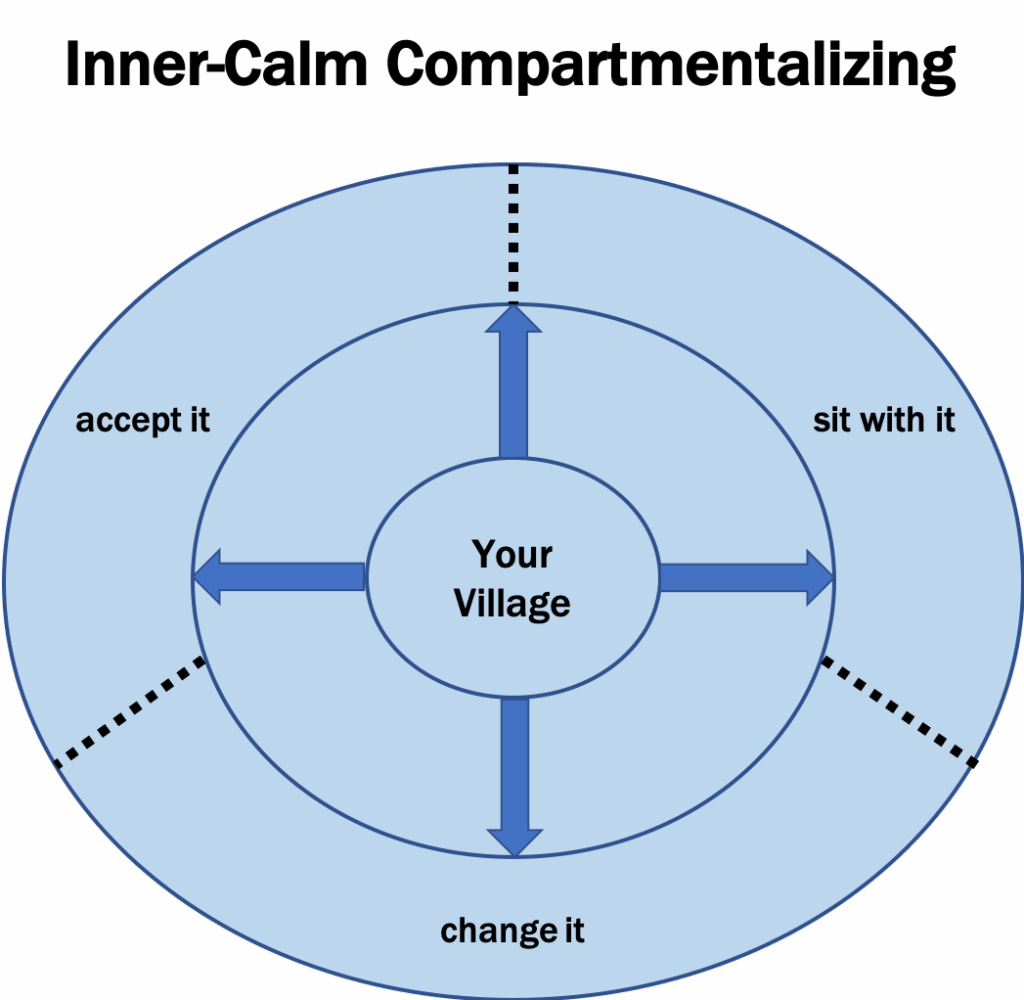
I’ll explain, starting with the three circles you see. The largest, outermost circle represents all the adverse events that happen that bother you; often things that are hard to process or cause you concern and worry. In the center of the model, the smallest circle, is Your Village. This is your “inner-circle” within the vastly bigger outer world, the small community of people you care most about, family and friends you want to protect, help, be with, be happy with, grow with. At times when the adverse event or larger surrounding environment seems most troubling, Your Village expands (represented by the four arrows pointing outward). Meaning, even more of the total focus you have to allocate in your life goes to that inner circle. You can’t change the adverse event that happened, you can’t control what’s happening in the outer world, but you can place more focus on strengthening the bonds within Your Village, on fueling a mutually supportive community that finds warmth, solace, and happiness in one another. Your focus shifts even more to what matters most.
Now, of course, you’re blessed to live in a much bigger, extraordinary world, albeit peppered with plenty of adversity and things to be troubled by. And so, the cost of living on such an incredible planet is that you must deal with the concerning byproducts. That’s where the compartmentalization piece comes in – the three segments of the outermost circle. Here, you place troubling events into one of three “compartments:”
Regarding the adverse event, you can ultimately accept it, having arrived, through conscious effort, at least at an understanding of why that thing happened. (That doesn’t mean you have to like it, though).
You can sit with it. That is, it’s something you don’t really understand, you can’t really accept it, but you also can’t let it eat away at your sense of inner peace, dimming your worldview and causing you to spiral down in hopelessness. You can change your relationship with that event, letting it sit in the background, knowing that the impact still exists and won’t go away. In other words, you focus not on “letting go,” but “letting be.” (After all, “letting it go” is known as cognitive dismissal, one of the hardest things to do in all of psychology).
Or you can change it. Not all by yourself (although that’s great if you can). I mostly mean by taking small actions that flow against the current of negativity the bothersome event has created. Small actions that can feed into larger streams of change.
When the world seems like it’s conspiring to get you down, I hope this tool helps you stay up.
IMPLEMENTATION (one research-backed strategy, tip, or tool)
My most popular IMPLEMENTATION tip from 2025 was a time management approach called the Glass Jar Exercise. Here’s how it works.
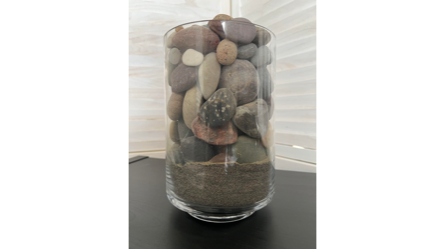
Imagine an empty glass jar. It represents a 24-hour day, with a finite amount of space to fill with activity. And it’s glass for a reason. Many of us work from home now, for at least part of the work week. Thus, how your work and life intermix is more visible than ever, literally. So you want that image to project prioritization and focus, among other things. Now, let’s plan how you’ll fill your day. You must fill your jar with three things, remembering there’s only so much space:
Sand – each grain represents a distraction or a small, unimportant task
Rocks – big, important tasks, and
Pebbles – tasks of average size and importance
First, fill the bottom of the jar with an inch or so of sand. This is reality. Despite best efforts, you WILL have distractions, emails, chats, calls, tweets, and unimportant, not urgent tasks that fill up too much of your day – especially when working from home. The key is to start your day saying “I must minimize how high the sand piles up today.” Do so by continually refocusing on what goes in the jar next.
Now, put the rocks in – your day’s biggest priorities. Remember, you can only fit so many rocks into the jar (it’s physics).
Finally, drop in a handful of pebbles – choose the tasks that can’t be delegated or put off until tomorrow. The key is not to let others add more pebbles (or rocks) to your jar during the day.
But now, a twist – courtesy of the working-from-home world. Working from home dramatically increases access to work, making it harder to “turn off the switch.” Boundaries disappear as you try to jam more pebbles, or rocks, into the jar. And the sand keeps flowing in, too. Eventually, something must give.
And that’s before you pour the water in the jar.
Water represents your family, leisure, and personal time. As boundaries evaporate when working from home, so does the water. Soon, work-life balance, or rather, sand-rock-pebble-water balance, has shattered (along with the glass around it).
But making the Glass Jar Exercise a habit helps you manage your time, life, and sense of overwhelm, far more effectively.
Leave a Reply