
INSIGHTS (on leadership/self-leadership)
Here’s a secret for empowering employees, helping them to feel ten feet tall.
Apply a veto mindset versus an approval mindset. I’ll explain.
As a leader, it’s easy to fall into your role as an approver – employees bring ideas and recommendations, you evaluate them, then give approval, or not, for them to execute that idea.
But what if, when an employee approaches you with an idea they want to run with, you default to, “Go!” You think, “Is there a strong reason for us not to do this?” “Is this really something I need to exercise my veto power on?” What if you believed the benefit of embracing an employee’s energy and passion, fueling their desire to lead something, outweighs the cost of their idea not working out?
It does. I’ve taken this approach and consistently found that this happens. Running with the employee’s idea releases their expenditure of discretionary energy, which leads to their initiative elsewhere. Which leads to greater performance, personal growth, and so on. All from resisting the veto mindset and asking, “Is this really something I have to ‘overrule’”?
IMPERFECTIONS (a mistake many make)
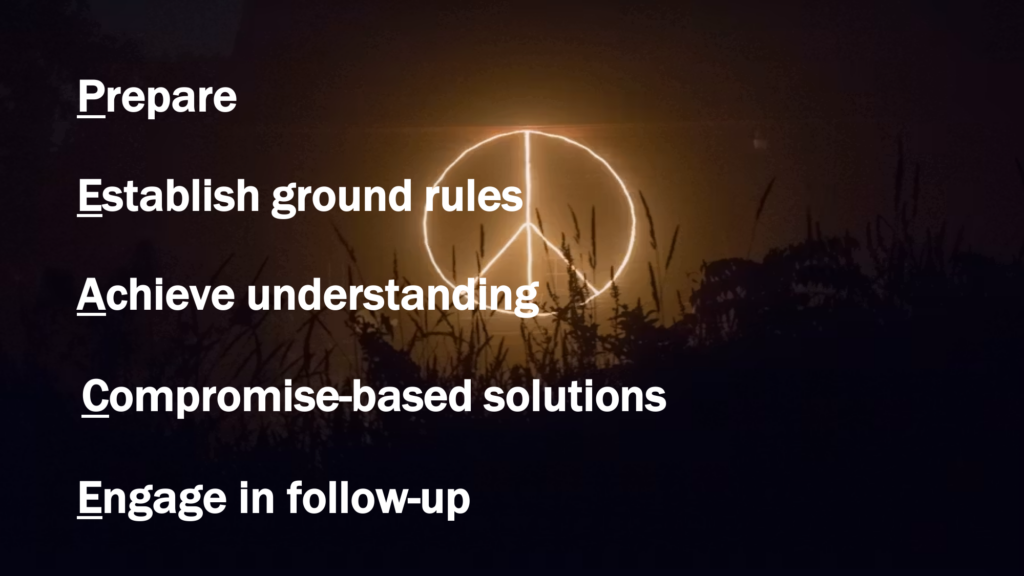
Few things cause more angst in the workplace than workplace conflict. The conflict itself isn’t a bad thing; it’s how you react to it that determines whether it’s productive or destructive conflict. The key is to have an organized system in place for mediating workplace conflict. That’s exactly what the PEACE Process is. PEACE is an acronym that outlines five steps for successfully guiding opposing sides through workplace conflict.
Prepare. As the mediator, you have to be calm and impartial. If you’re calm, it helps de-escalate what otherwise might be an emotion-filled, heated conversation. Talk with the different factions in conflict beforehand to gain a preliminary understanding of the issue and to anticipate potential tensions that could arise during the conflict-resolution discussion. Choose a neutral location for the discussion to avoid any appearance of favoritism.
Establish ground rules. When it’s time for the conflict resolution conversation, it’s essential to set the tone right from the start of the meeting. Clarify the goal of the discussion, which is to get to a mutually agreeable solution to the conflict. Make it clear that respect from all sides is a non-negotiable, as is a commitment to actively listen to the other side without interrupting and with the intent to understand. Personal attacks are not welcome. Use “I” centered vs. “You” centered statements.
Achieve understanding. This is about facilitating the conversation and giving each side a voice, allowing them to share their perspective in a safe space where everyone feels heard. It’s important here to keep everyone focused on sharing facts and identifying the underlying problems, not attacking or blaming personalities in the room. It’s about clarifying misunderstandings, challenging assumptions, and getting to an understanding of the real issues while discouraging hidden agendas.
Compromise-based solutions. This is where, after having listened to all sides, you identify common values and goals. This brings people together and creates a foundation on which to build a compromise-based solution. Brainstorm and discuss multiple options as a group with common interests, all to find a workable solution that everyone can support and commit to.
Engage in follow-up. This is about checking in with all sides to ensure they’re adhering to the agreements reached and to confirm that the conflict has indeed been resolved. It also provides an opportunity to discuss how to prevent similar conflicts in the future.
So, use the PEACE Process to make it much easier to keep the peace in your workplace.
IMPLEMENTATION (one research-backed strategy, tip, or tool)
Can’t give out bonuses at work? How about giving people an emotional bonus?
The idea is simple. Think of surprising, meaningful ways you can show appreciation that will produce a boost in feeling cared for and valued. That’s it. As an example, I liked to invite key employees to an appreciation dinner, then have my wife and daughter show up at the dinner to hand deliver a gift to those employees. Why? It was because of my employee’s great work that I was able to be home, present, and relaxed with my family. In that way, my family thanks them as well. The gesture strikes an emotional chord with the employees, and, I believe, has an even greater impact than a financial bonus.
How might you give out emotional bonuses at work (and in life)?


Leave a Reply