
INSIGHTS (on leadership/self-leadership)
Recent Gallup research showed the number one thing employees are looking for from their leaders in today’s workplace. And it’s not even close.
Hope.
56 percent of the global employees surveyed said hope was the top need, which far outpaced the number two need, trust (33 percent said this was the most important need). Gallup defines hope as “The need to feel positive about the future and for leaders to provide a clear direction.”
The research indicates three of the most effective ways to provide hope (which is an active, not passive, endeavor):
1) Help employees feel enthusiastic about the future by providing an inspiring vision
2) Help employees understand their role in achieving the vision and connect them to the purpose in their work
3) Set tangible and realistic goals
IMPERFECTIONS (a mistake many make)
One area where it’s easy for any of us to make mistakes is negotiation. It’s inherently filled with tension as two (or more) sides battle to get what they want. That’s why this piece caught my attention, as it shares Harvard research indicating that most of us try to be too warm and friendly in negotiations. Negotiators who do better tend to be “tough and firm.” That doesn’t mean you have to be a jerk or that you can’t start negotiations on a warm and friendly note, but when it’s time to get down to business, firmness is essential. In fact, nine magic words can help you do this:
If you can do (X), we have a deal.
It’s effective because you’ve set clear terms and specific criteria, leaving no room for counteroffers. It shows that you’re prepared, have thought through your terms, and know exactly how much whatever you’re negotiating is worth to you.
So, for your next negotiation, remember these nine words, and the other side won’t have nine lives in terms of counteroffers.
IMPLEMENTATION (one research-backed strategy, tip, or tool)
One of the most consistently highly regarded prioritization tools you can embrace is called timeboxing. Timeboxing takes the classic To-Do list and reimagines it, by focusing that To-Do list and calendarizing it in chunks of time, or “timeboxes,” that you commit to on a calendar, like so:
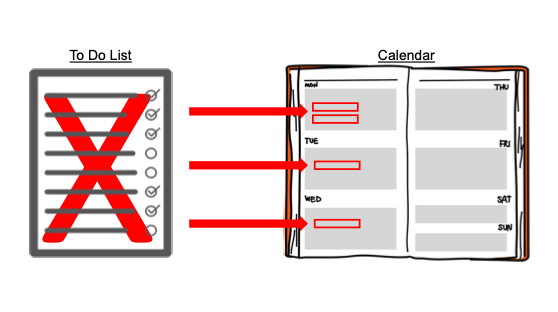
The key is to assign a fixed period of time to a To-Do item, schedule it, and stick to it. Here’s a simple example. As you look to your week ahead, you look at your To Do list and decide the three most important things to accomplish on Monday and Tuesday are to 1) complete a report, 2) develop a sales presentation, and 3) prepare for a big Wednesday meeting. You estimate how long you’ll need to spend on each task and then block off time on the calendar accordingly.
Here’s what that looks like:
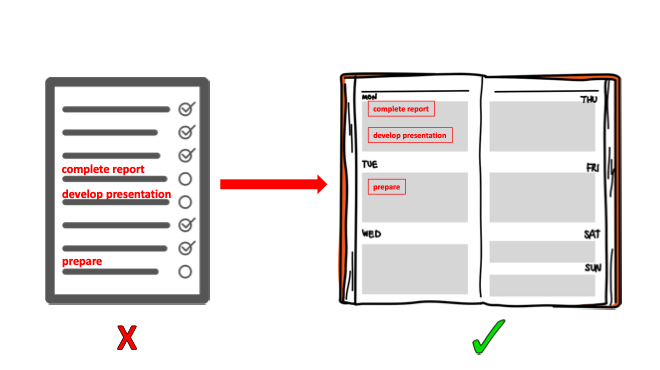
Then it’s about sticking to that schedule.
Why is this method effective? Because To-Do lists typically contain way too many items that aren’t well prioritized, and because they enable the anti-productivity habit of doing the easiest tasks first for a sense of accomplishment (even though those items are rarely the most important). Instead, timeboxing helps you get the right things done at the right time. For example, you can schedule the toughest tasks for the times when you know your energy will be highest. Timeboxing also forces you to schedule things that aren’t necessarily urgent, like taking time for learning or to do a fun activity, but that are still important, and that you tend to never get to.
Here’s what you’ll discover when you try timeboxing:
1) It takes discipline, but it pays off. You have to think through in advance how long each task will take and which tasks are really the most important, and then be brutal about working that task to completion within the time allotment you gave it. At first, you might stink at estimating “time for completion,” but you’ll get better as you go along. You’ll also find that with timeboxing, you avoid Parkinson’s Law, which says that work expands to fill the time available for its completion. You’ll end up telling yourself, “There’s only a half an hour left in this timebox, I’ve got to get this done!” And by staying disciplined, you do.
2) You’ll gain a deeper sense of accomplishment. Timeboxing helps ensure that the most important things get done first, so your sense of achievement runs deeper.
3) You might end up blending the traditional To-Do list with timeboxing. Especially if you like the visual of the stacked To-Do list, which can create a sense of thoroughness and control. But you can still timebox the most important items on that To-Do list, and mark on the list (with a little square) that the item has been timeboxed on your calendar. That way, in the space between timeboxed events, you can still achieve a sense of accomplishment by completing and crossing off a few of the more mindless, less urgent tasks on the To-Do list.

Leave a Reply