INSIGHTS (on leadership/self-leadership)
When the Oracle of Omaha, Warren Buffett, dispenses investing advice, there are often hidden, or not so hidden, life-lessons within. Well, he’s done it again, this time in summing up the 2026 financial markets. He has long said that the markets are like a church with a casino attached. The church represents the need for long-term investment, and the casino is where you speculate and take some risks or patent gambles. Both buildings should co-exist in harmony. But the problem is, the casino has become much more attractive to people. As evidence, he pointed to the rise of day traders and prediction markets (like Polymarket).
The balance is out of whack.
Which brings up a related question.
How is the balance in your life between the things you know you should be investing in for the long term (like relationships, savings accounts, your learning and growth, your mental and physical health, etc.) and the speculative risks you’re focused on (getting that promotion, buying that expensive car in hopes it brings some joy, blowing off those friends because you’re not in the mood)?
The church and the casino can co-exist. Just remember which building leads to higher-order returns.
IMPERFECTIONS (a mistake many make)
I was recently asked after a keynote, “What’s the biggest mistake people make in trying to achieve success, and how do you overcome it?”
I was surprised by how fast I gave this answer:
Be stronger than your excuses.
Easier said than done, I know, as there’s an almost gravitational pull towards excuse-making. You make them because inertia is easier, because you doubt yourself, you’re afraid, you think you’re not ready, you don’t feel motivated, or you don’t know what to do. This last one, especially, can lock us in a pattern of shutting down. But being stronger than your excuses means knowing what to do when you don’t know what to do. It means pushing through. It means facing reality, which you avoid when you make excuses. It means refusing to play the victim.
And here’s the harshest truth: the opposite of progress is excuses.
So, don’t make the mistake of giving in to the siren call of the excuse. Be stronger.

IMPLEMENTATION (one research-backed strategy, tip, or tool)
I’ve written about how to drive accountability in several contexts, including a lesson about accountability taught at a urinal, the importance of compassionate accountability, and more.
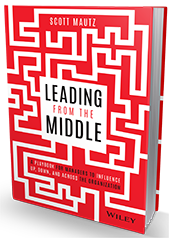
I write about it because readers ask about it. A lot. So, in this issue, I wanted to share a powerful reminder I included in my book, Leading from the Middle. Achieving a sense of accountability with your team doesn’t have to be overly complicated. In fact, it’s about achieving clarity on five things:
• Expectations
• Capability (resources/skills required to complete the work)
• Measurement
• Feedback
• Consequences
I’m not saying delivering clarity on these elements is easy, but doing so is a focused, compact way to efficiently get your “80 for the 20” on driving accountability on your team.

Leave a Reply